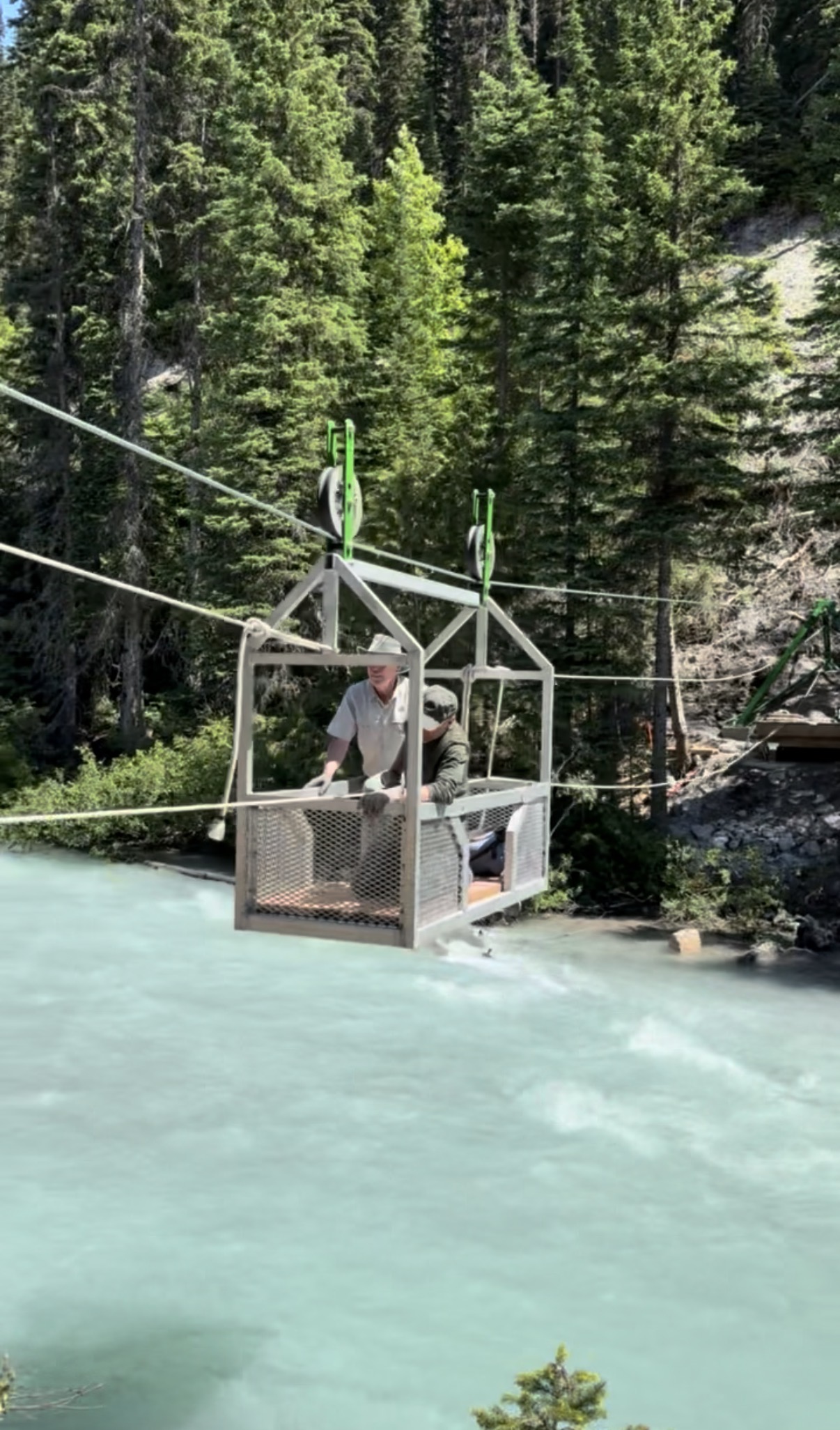
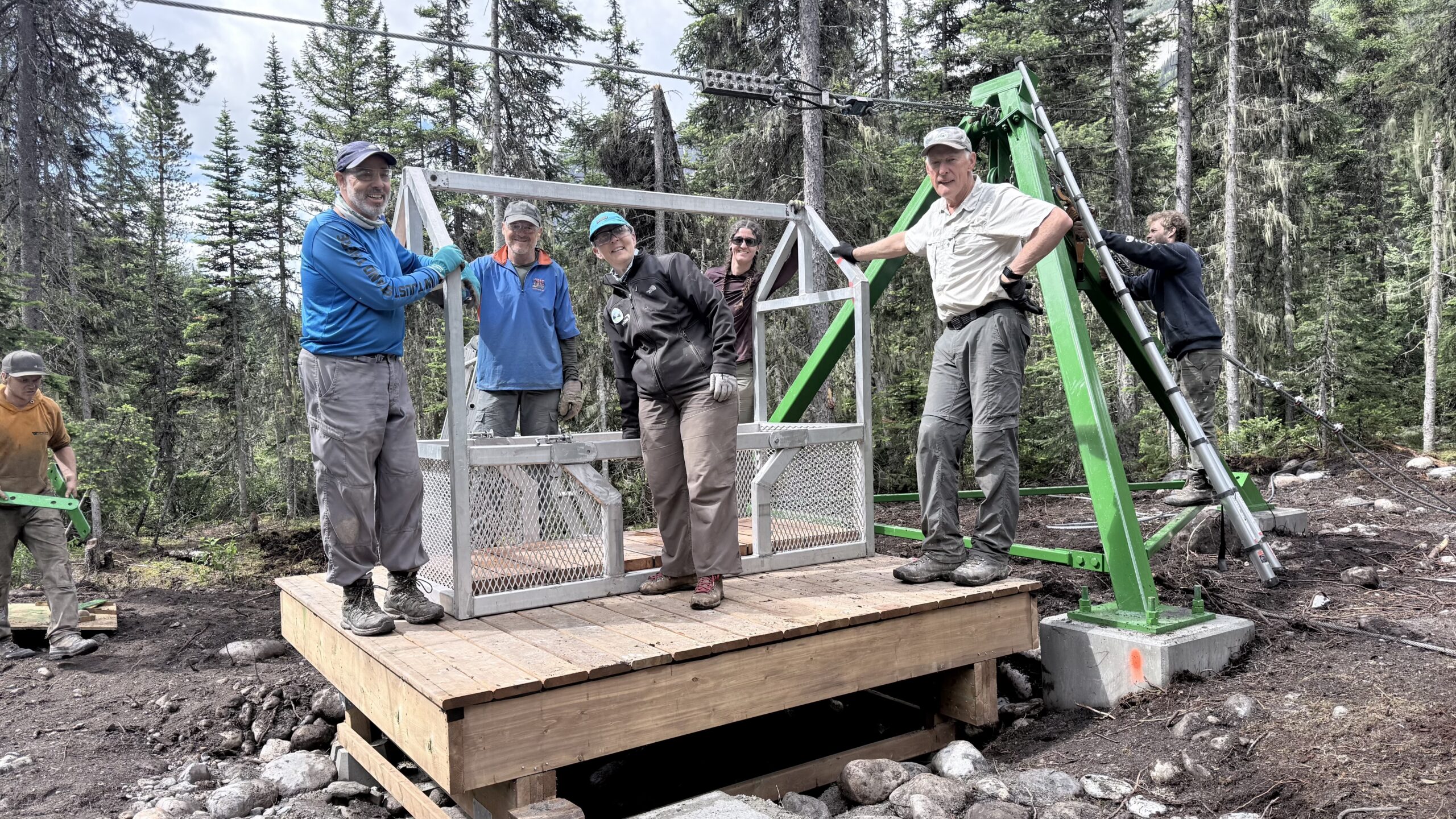
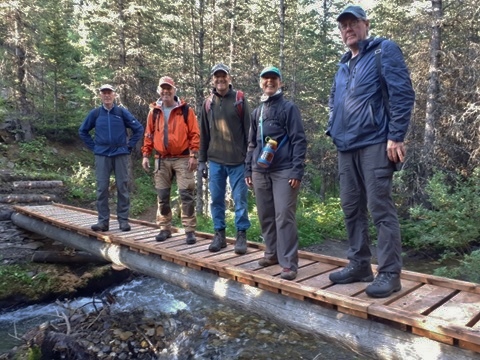
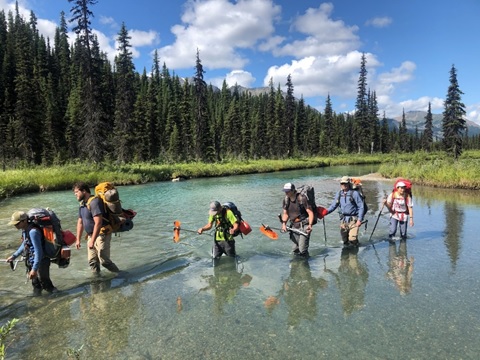
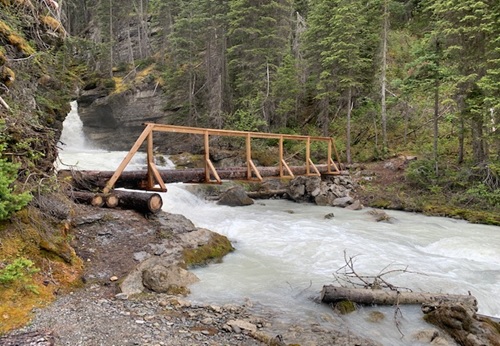
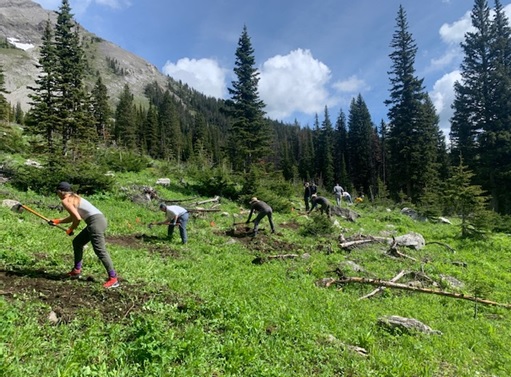
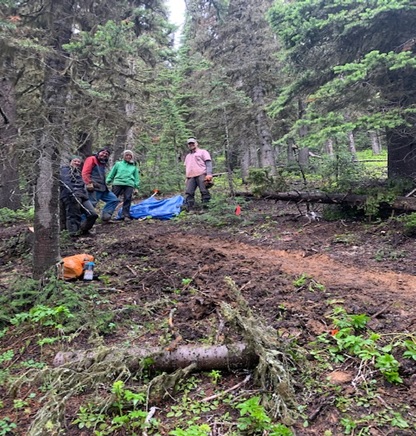
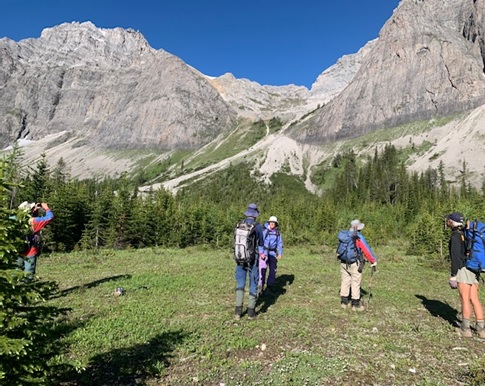
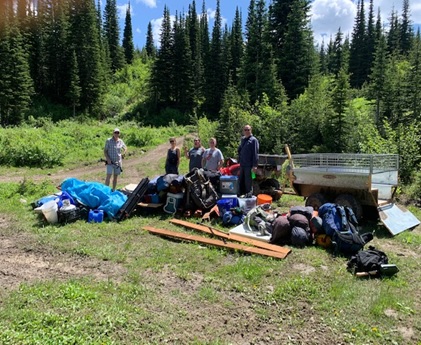
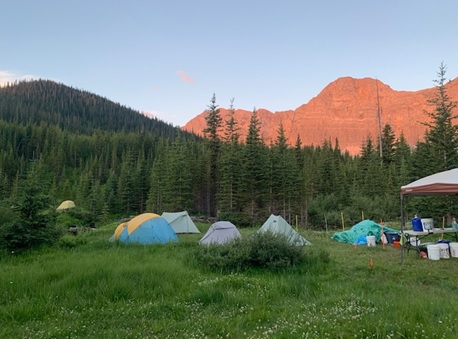
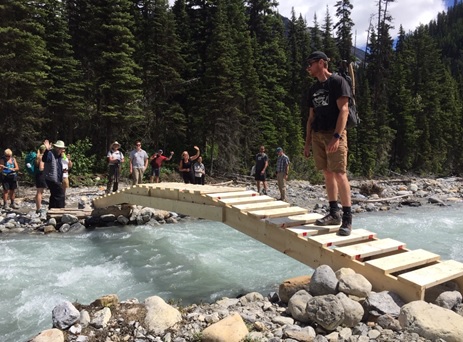
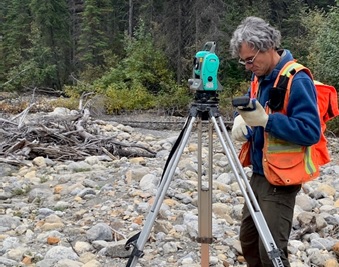
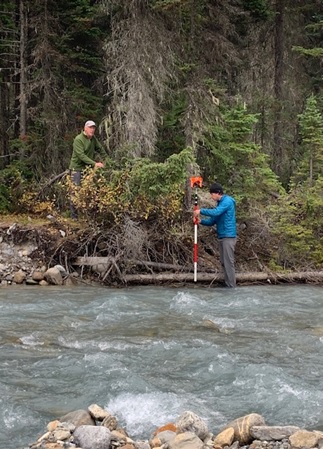
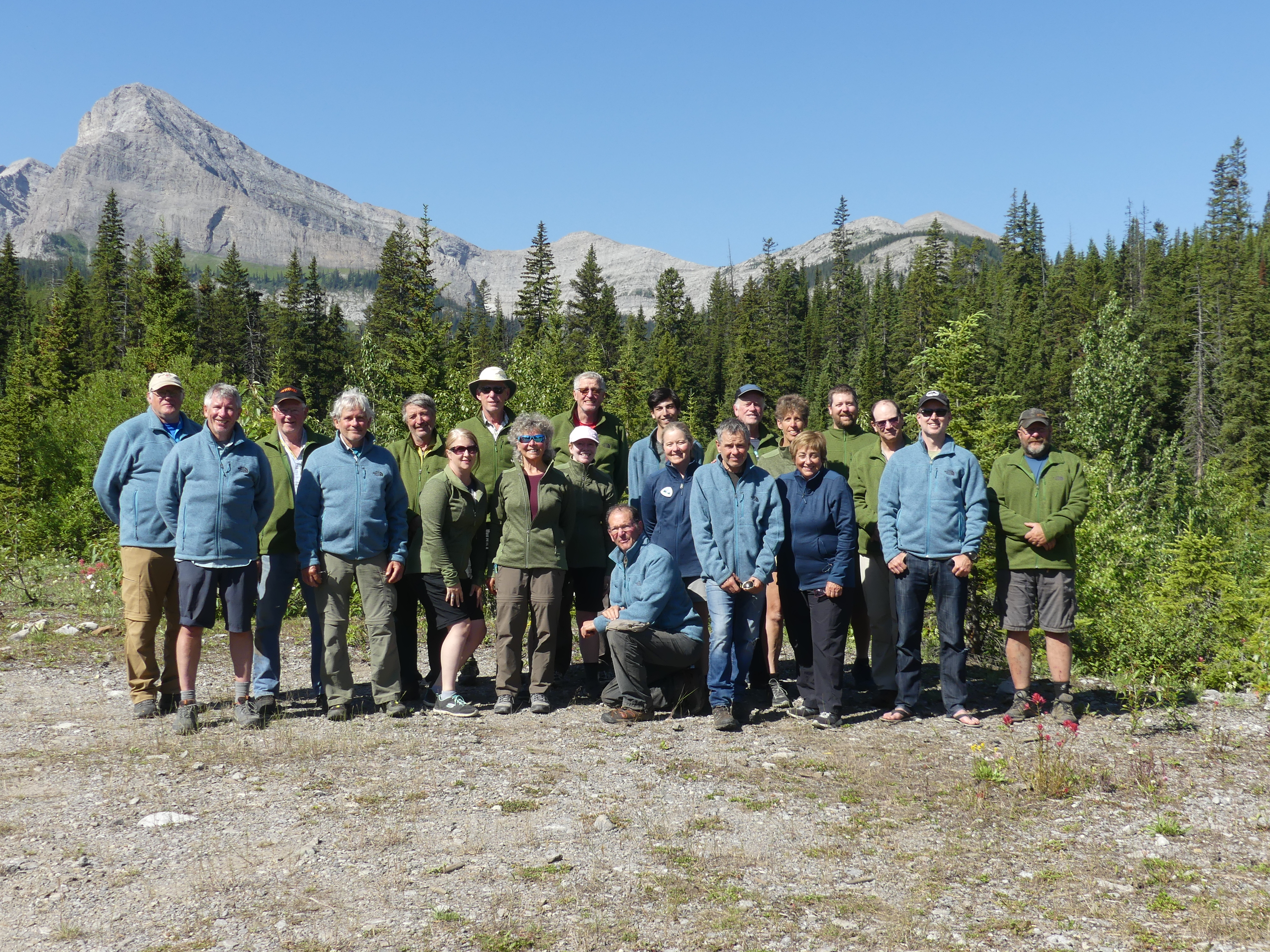
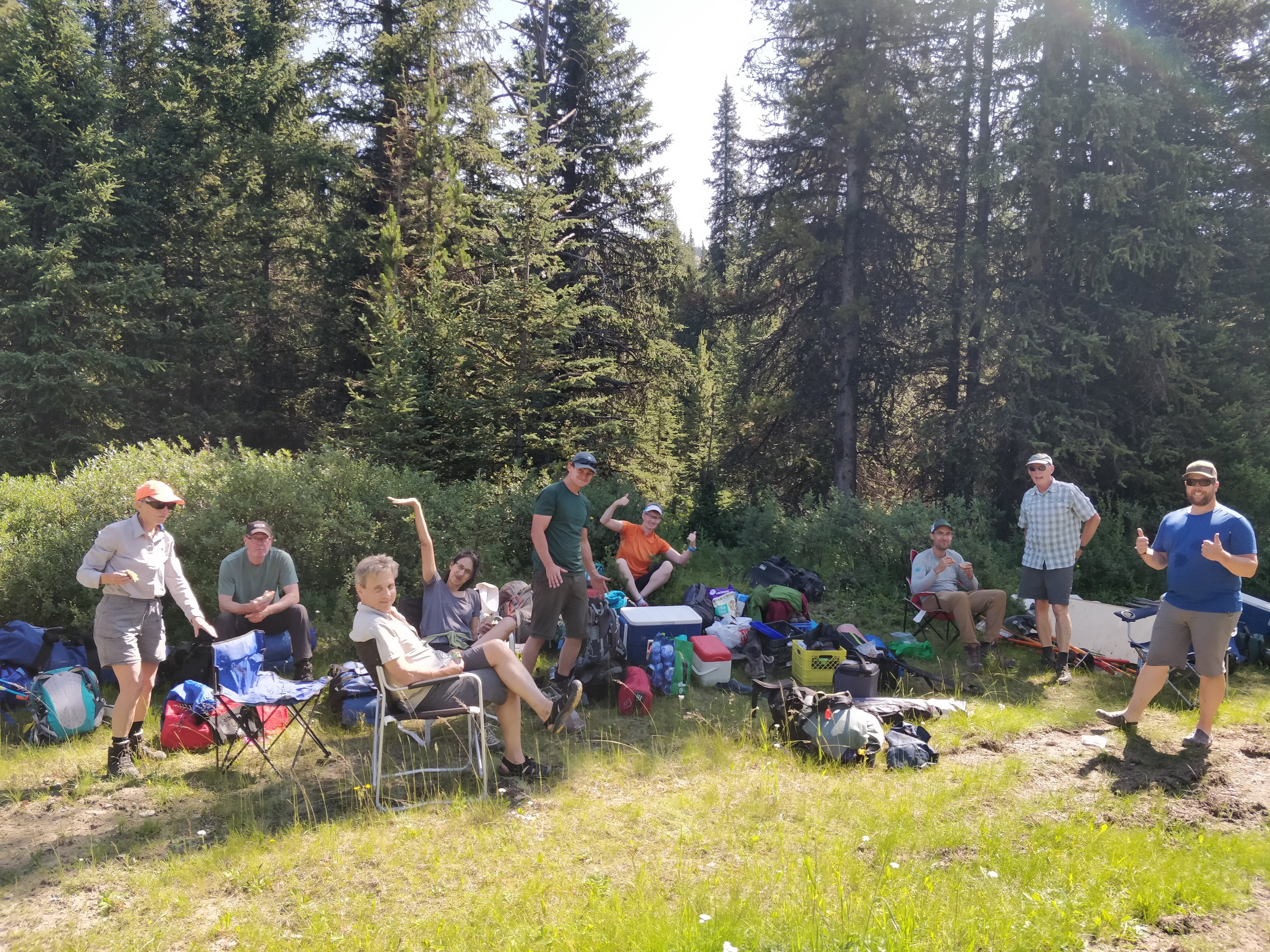
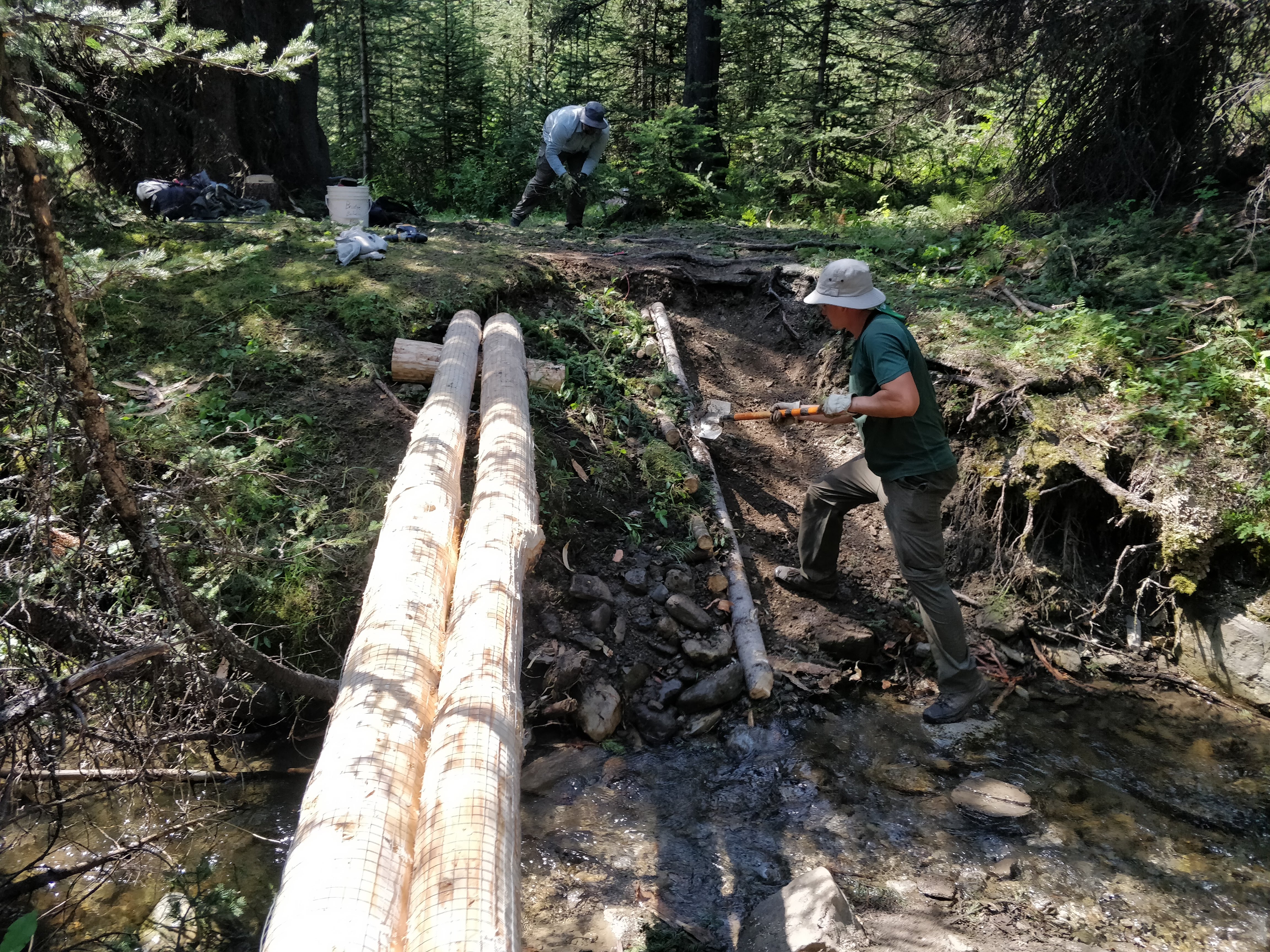
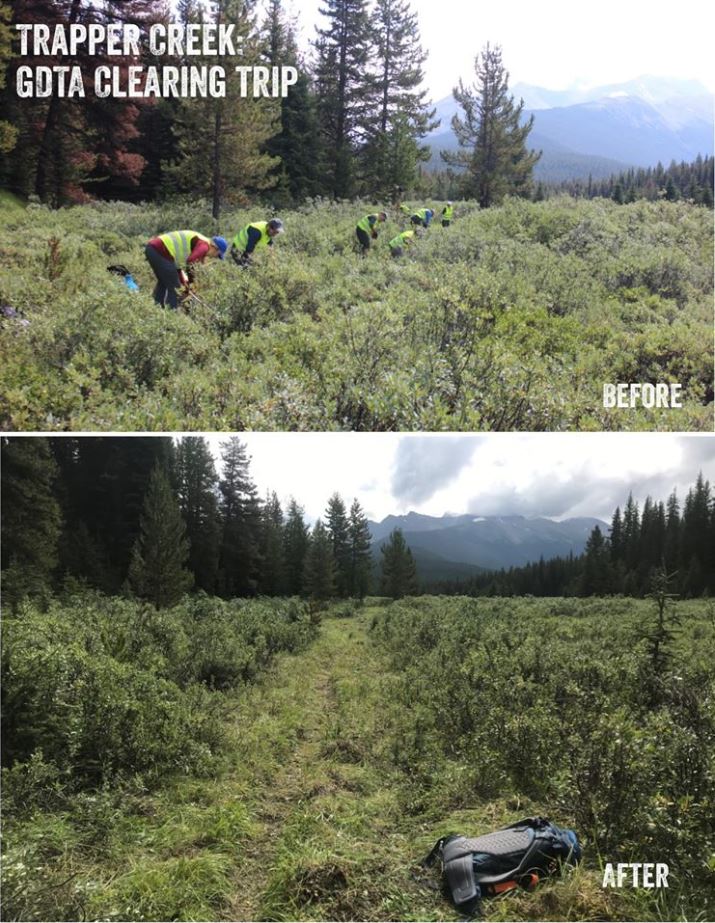
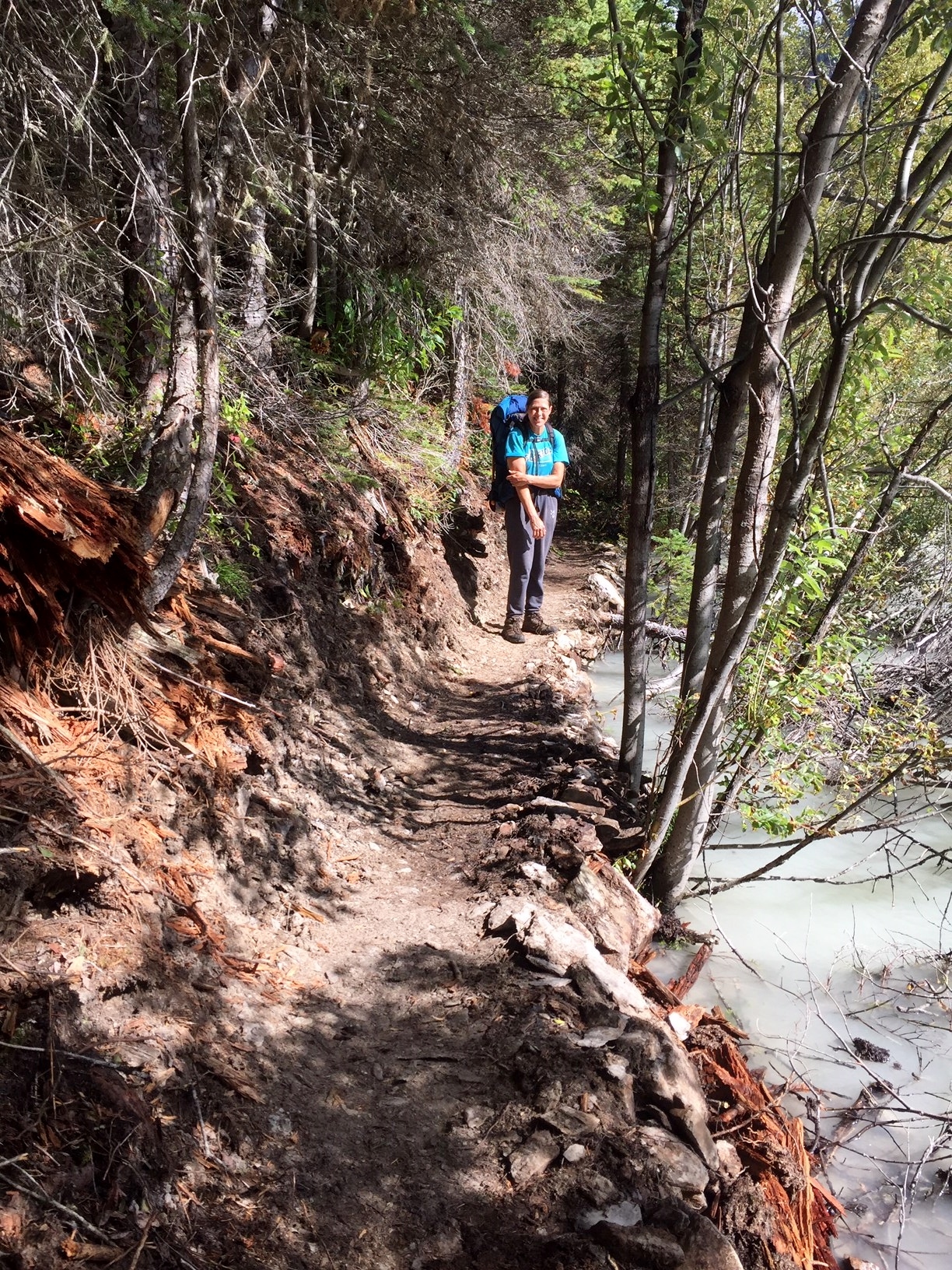
After five years of planning, collaboration, fundraising, and an incredible amount of volunteer effort, we are more than excited to announce that the Blaeberry Cable Car is complete and officially open for hiker use, just in time for the 2026 Great Divide Trail hiking season.
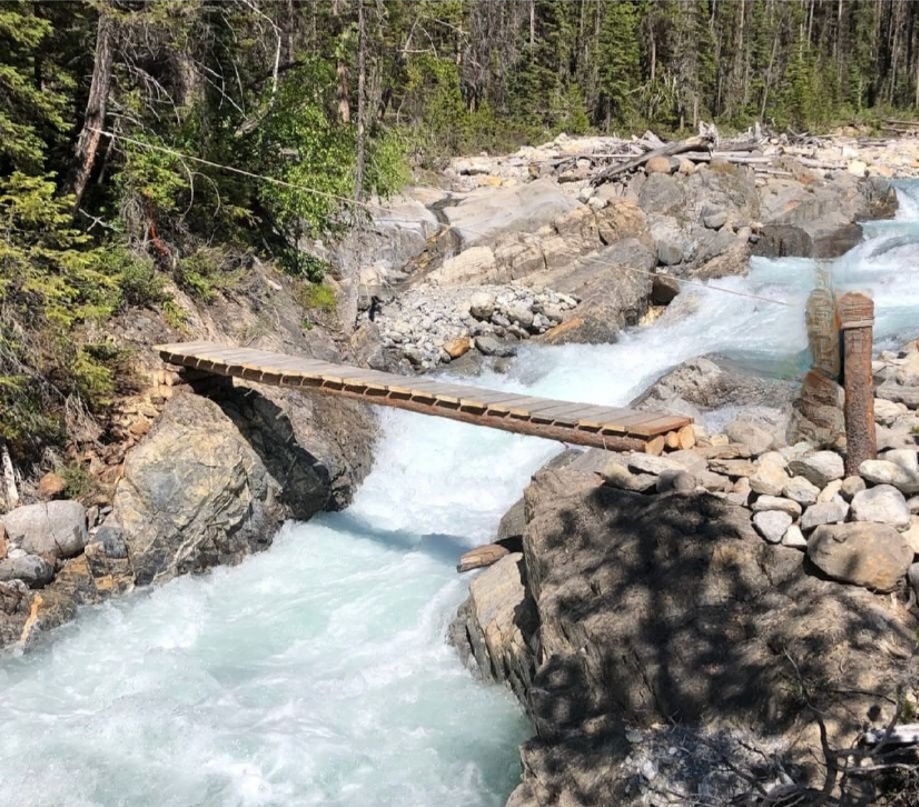
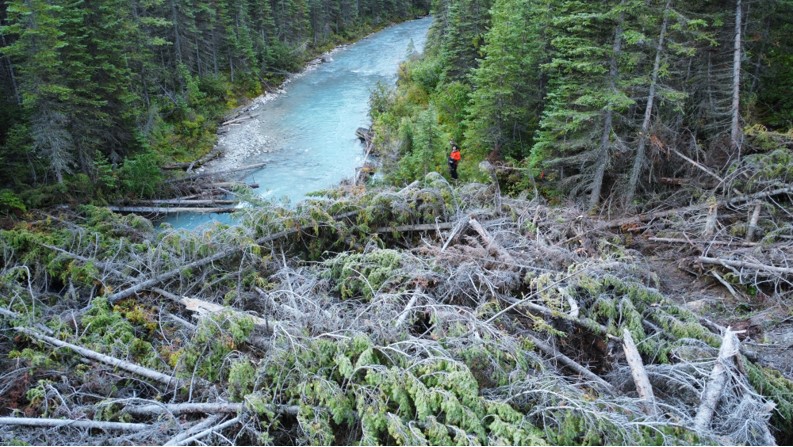
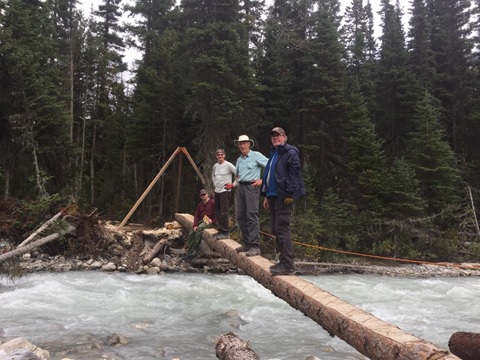
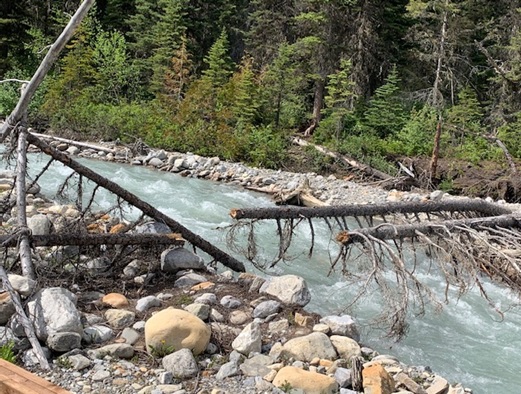
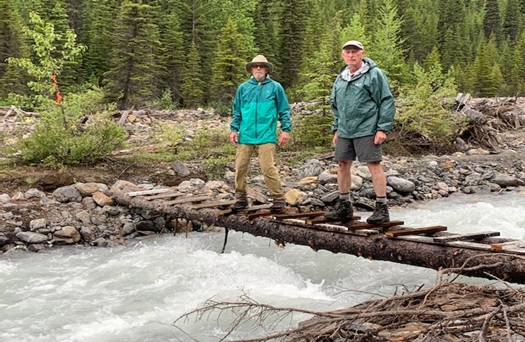
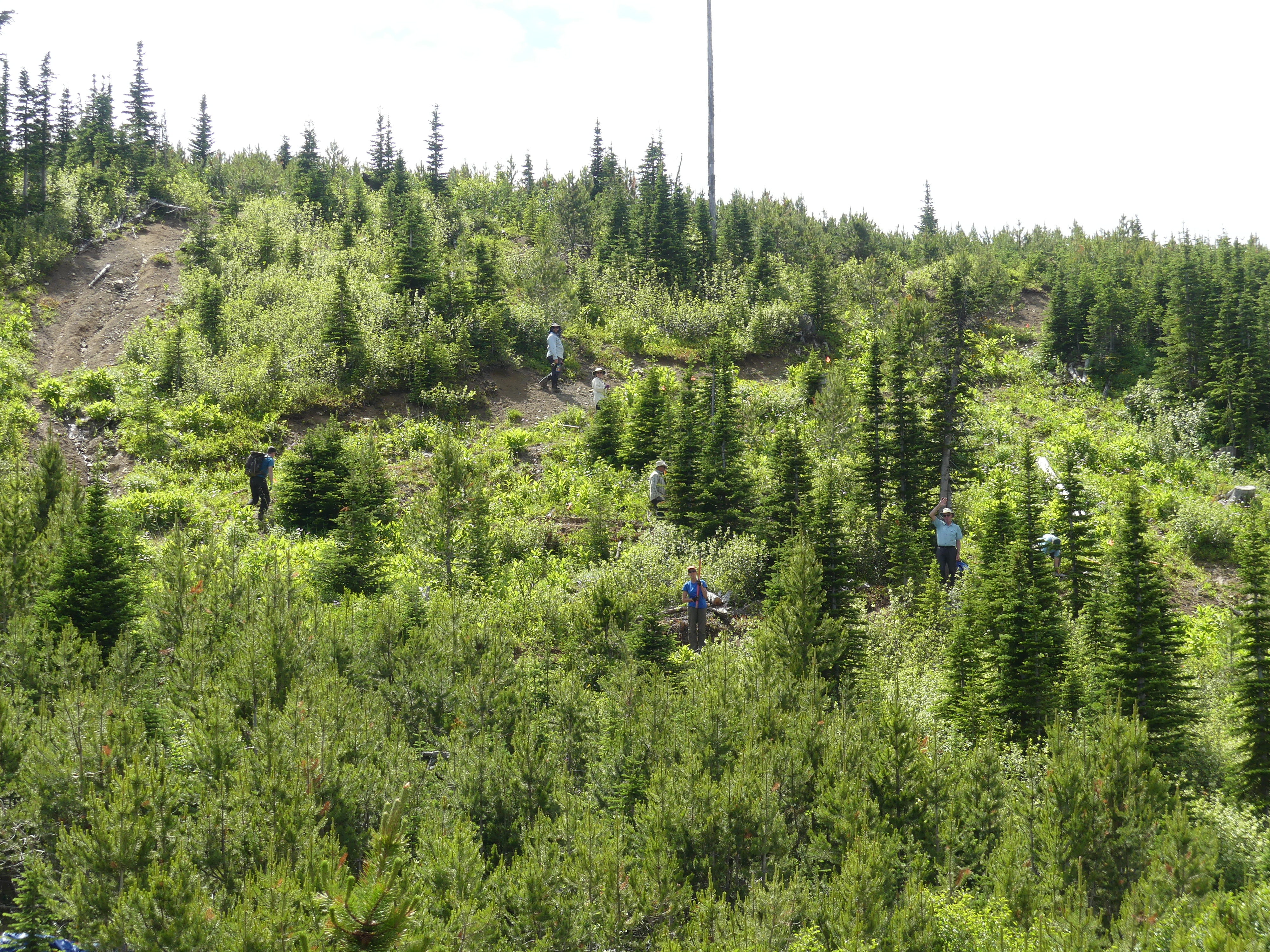
Located in the middle of Section D of the Great Divide Trail, the new cable car provides a safe and reliable crossing of the Blaeberry River, replacing the temporary log bridge that had served hikers in recent years. What began as a proposal for a permanent aluminum bridge evolved into the Great Divide Trail’s first cable car aerial ferry, creating a unique and memorable experience while dramatically improving safety. The new cable car also enables a major enhancement to the hiker experience in the Blaeberry Valley, by eventually allowing the Collie Creek Alternate to become the official route of the GDT, replacing a tedious 14-km road walk with a scenic forested footpath that’s now usable by all hikers.
The first official Great Divide Trail hiker to use the new crossing was Mark Donald, who rode the cable car on Tuesday, July 7, 2026, making for an exciting moment!
Projects like this are never accomplished by one organization alone, and this one is no exception.
First and foremost, we extend thanks to Recreation Sites & Trails BC for working alongside the GDTA, helping solve challenges, navigate approvals, and ultimately bring this ambitious vision to life.
We also thank BC Parks for donating the cable car towers and cart. This contribution made the project possible and provided the foundation for what has become one of the most unique pieces of backcountry infrastructure on the Great Divide Trail.
A very special thank you goes to Brendan Harvey of Upslope Millwright & Rigging. Brendan’s expertise, ingenuity, and countless hours of work were absolutely essential to the successful completion of the cable car. Without his knowledge, skills, and commitment, this project could not have been completed.
We are also incredibly grateful to the Columbia Basin Trust for believing in this project from the beginning. Their financial support, and their willingness to stay with us as the project evolved over several years, helped carry this vision through to completion.
This project was also made possible through the generosity of our supporters. Thank you to every individual who contributed, whether through direct donations or by supporting our Trail Supporter campaign with the Blaeberry Crossing in mind. Every contribution helped move this project forward.
We would like to recognize one remarkable act of generosity. An anonymous donor stepped forward with an extraordinary $60,000 donation, providing the final funding needed to bring the project across the finish line. We are profoundly grateful for this incredible gift and the confidence it demonstrates in the future of the Great Divide Trail.
Last but certainly not least, we extend our deepest appreciation to the many GDTA volunteers who made this project possible. In particular, we want to recognize our trip leaders Dave Higgins and Stuart Mitchell, who dedicated an incredible amount of time, energy, skill, and effort, not to mention years, to bringing this project to life. From planning and organizing work trips to hauling materials, solving challenges in the field, and putting in countless hours of hard work in a remote and demanding environment, their commitment was truly extraordinary. This project is a reflection of the passion and dedication of our volunteer community, and we cannot thank them enough for everything they have contributed.
The completion of the Blaeberry Cable Car is much more than the installation of a new river crossing. It is a testament to what can be achieved when government agencies, community partners, skilled professionals, volunteers, donors, and trail supporters work together toward a common goal.
To everyone who contributed your time, expertise, funding, equipment, or encouragement over the past four years, thank you.
We look forward to welcoming hikers to experience the Blaeberry Cable Car throughout the 2026 hiking season and for many years to come.
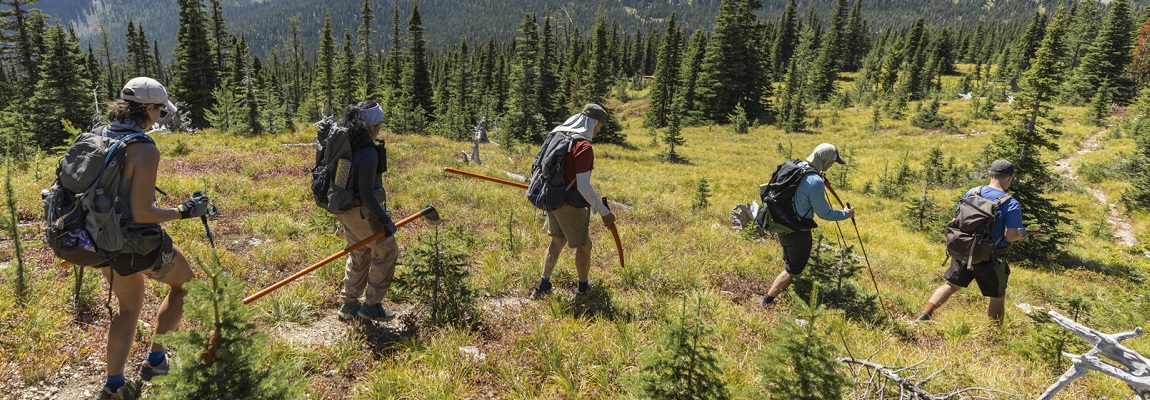
Bust out your camping gear because the dates and locations for our 2026 trail building and maintenance trips have been set and we invite you to join us!
This year, we have a wide range of volunteer opportunities, with 3 trail building trips on the High Rock Trail (HRT) to finish construction of the Erris Lake Trail; two trips to the upper Blaeberry to build a cable car and maintain the David Thompson Heritage Trail; two maintenance trips to Cache Creek on the Original GDT; a maintenance trip on the Maligne Pass Trail in Jasper National Park; a helicopter-supported trip to Colonel Creek in Mount Robson Provincial Park; and a backcountry maintenance trip up to Palliser Pass in Height of the Rockies Provincial Park.
Our work is made possible by the support of the Government of Alberta, Durston, Columbia Basin Trust, the Alberta Equestrian Federation, BC Parks, Recreation Sites & Trails BC, and the generous individual and corporate donors from our Trail Supporter Campaign. A sincere thank you to all who make our initiatives possible! We look forward to another productive year.
Please bear in mind that unforeseen circumstances may sometimes lead to changes in trip dates and locations. Rest assured; we will promptly notify volunteers of any such adjustments.
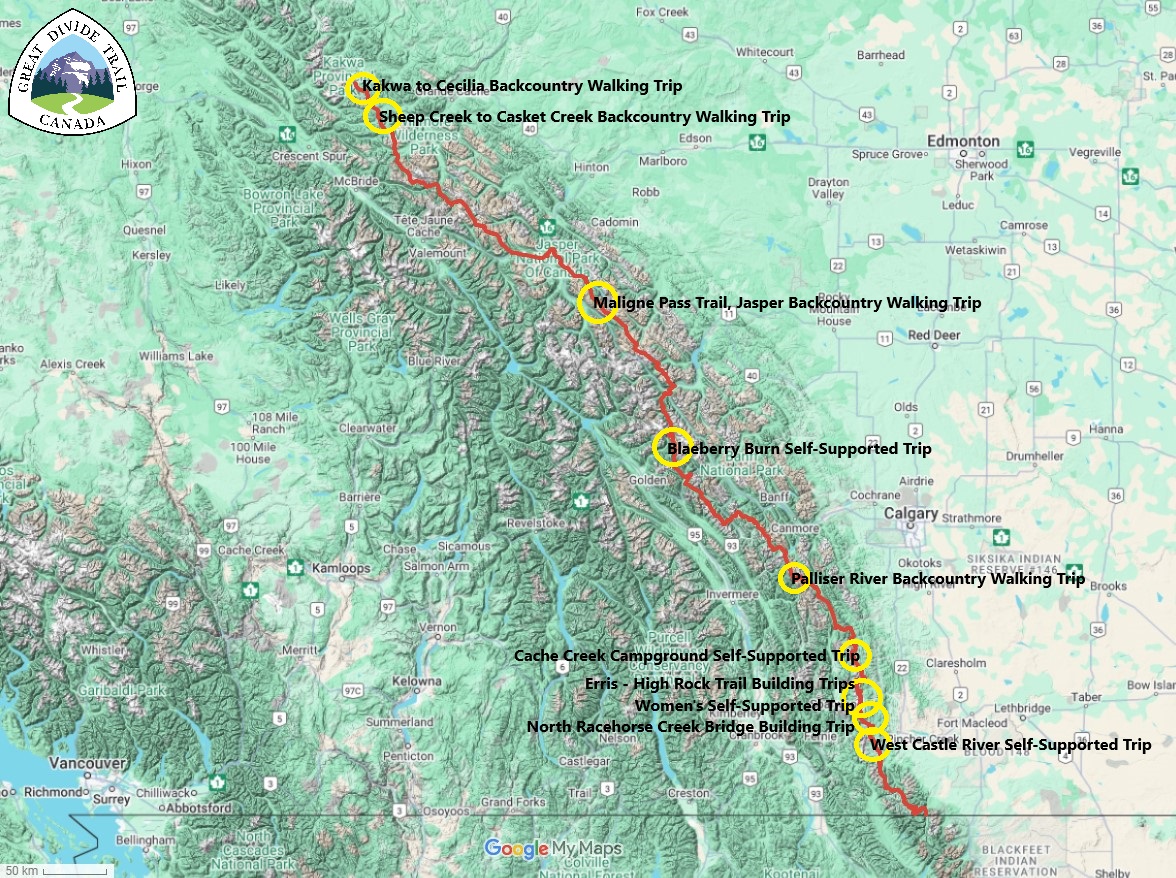
Check out the map below of this year’s Trail Building & Maintenance Trips:
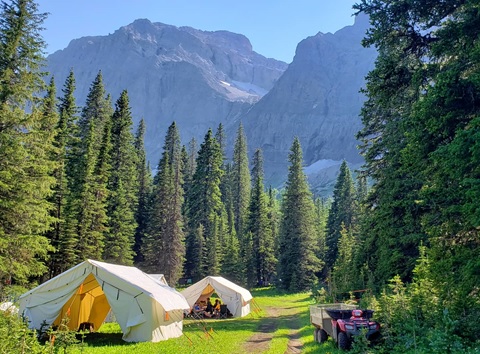
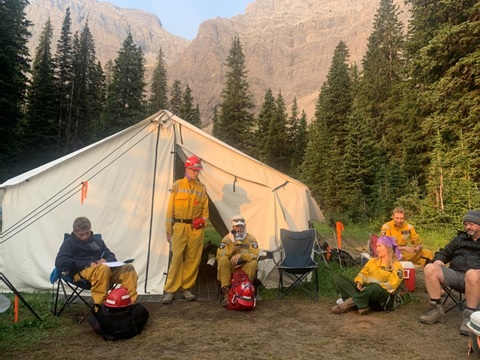
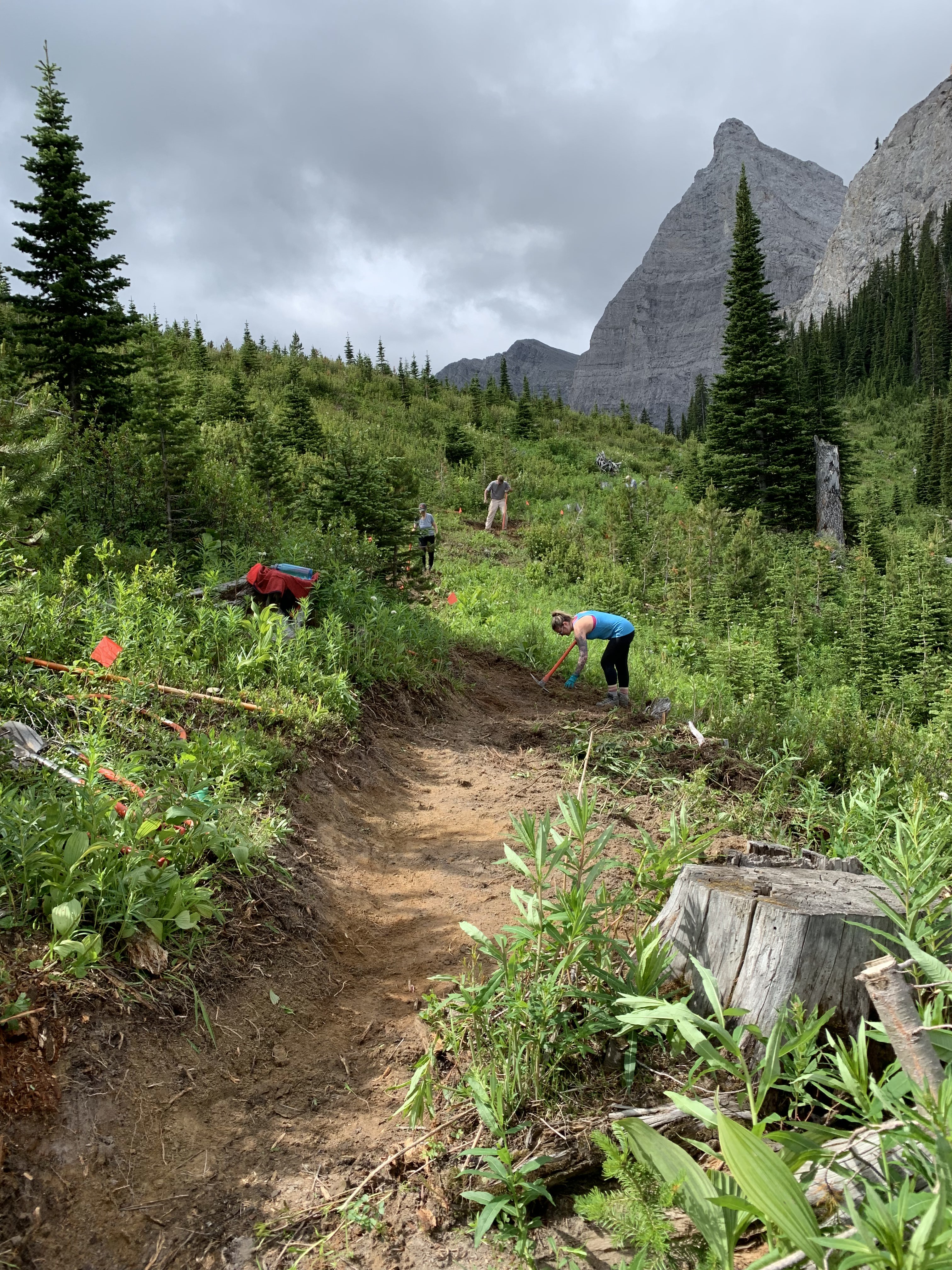
Trip #1 June 19-24 – Blaeberry Cable Car Base Camp Trip A (maximum 8 volunteers): This trip will focus on starting construction of a cable car across the Blaeberry River. Technical construction will be completed by a contractor while volunteers will assist with non-technical work and trail maintenance. Volunteers will be able to drive to base camp. Volunteers should have backcountry camping experience and must bring their own food and camping gear. Trip leader: Dave Higgins
Trip #2 June 25-30 – Blaeberry Cable Car Base Camp Trip B(maximum 8 volunteers): This trip will focus on finishing construction of a cable car across the Blaeberry River. Technical construction will be completed by a contractor while volunteers will assist with non-technical work and trail maintenance. Volunteers will be able to drive to base camp. Volunteers should have backcountry camping experience and must bring their own food and camping gear. Trip leader: Dave Higgins
Trip #3 June 26-28 – HRT Erris Remote Base Camp Trip A(maximum 4 volunteers): This trip will focus on recon and base camp set-up. Volunteers should have backcountry camping experience and must be able to hike 8 km to remote base camp carrying personal backpacks with their own food and camping gear. Helicopter will transport base camp facilities, including cook tent, wood stove, two cooking stoves, latrine, water filtration system, dish-washing station, and bear-proof food storage area. Trip leader: Dave Hockey
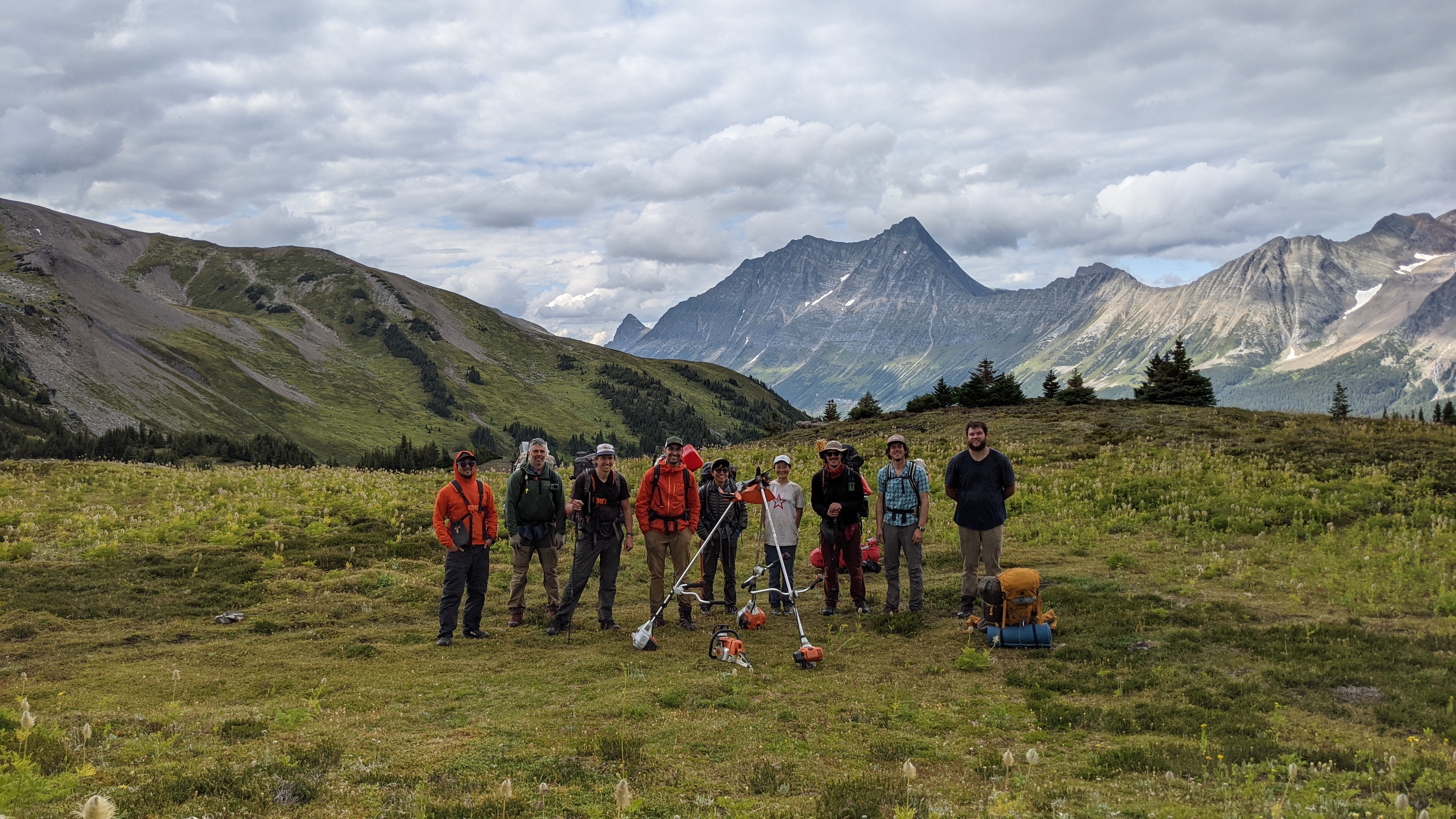
Trip #4 July 3-9 – Palliser River Backcountry Walking Trip (maximum 8 volunteers): This trip will focus on trail maintenance in Height of the Rockies Provincial Park. Volunteers must have backcountry camping experience and be able to hike up to 20 km carrying their own food and camping gear, and up to 10 km carrying power and hand tools. We require at least two volunteers with brush saw or chainsaw experience. If you’re interested in getting trained and certified to use a chainsaw or brush saw, let us know! Trip leader: Deb Yanchula
Trip #5 July 8-13 – HRT Erris Remote Base Camp Trip C(maximum 15 volunteers): This trip will focus on building trail between Erris Lake and Clay Lake. Volunteers should have backcountry camping experience and must be able to hike 8 km to remote base camp carrying personal backpacks with their own food and camping gear. Volunteers will use base camp from Trip #3 with cook tent, wood stove, two cooking stoves, latrine, water filtration system, dish-washing station, and bear-proof food storage area. Trip leaders: Dave Hockey, Jim Schieck
Trip #6 July 14-19 – HRT Erris Remote Base Camp Trip D (maximum 15 volunteers): This trip will focus on building trail between Erris Lake and Clay Lake, and base camp take-down on the last day. Volunteers should have backcountry camping experience and must be able to hike 8 km to remote base camp carrying personal backpacks with their own food and camping gear. Volunteers will use base camp from Trips #3 & 5 with cook tent, wood stove, two cooking stoves, latrine, water filtration system, dish-washing station, and bear-proof food storage area. Trip leader: Dave Hockey
Trip #7 August 14-20 – Cache Creek Base Camp Trip(maximum 10 volunteers): This trip will focus on trail maintenance, campground improvements, and small bridge construction. Volunteers must be able to hike up to 5 km per day carrying daypacks and tools. Volunteers will be able to drive right to base camp. Volunteers must bring their own food and camping gear. Trip leader: Stuart Mitchell
Trip #8 August 14-16 – Cache Creek Weekend Base Camp Trip(maximum 6 volunteers): This shorter trip will focus on trail maintenance and campground improvements. Volunteers must be able to hike up to 5 km per day carrying daypacks and tools. Volunteers will be able to drive right to base camp. Volunteers must bring their own food and camping gear. Trip leader: Stuart Mitchell
Trip #9 August 26-30 – Maligne Pass Trail, Jasper Backcountry Walking Trip(maximum 10 volunteers): This trip will focus on trail maintenance in Jasper National Park. Volunteers must have backcountry camping experience and be able to hike up to 20 km in a day carrying their own camping gear and hand tools. The Maligne River must be forded, normally knee-deep but it may be more than 3’ deep if the water is high. Volunteers must bring their own food and camping gear. Trip leader: Josh Edwards
Trip #10 September 8-12 – Colonel Creek Self-Supported Trip(maximum 4 volunteers): This trip will focus on trail maintenance in Mount Robson Provincial Park. Volunteers must have backcountry camping experience and be able to hike up to 10 km in a day carrying day packs, power tools and hand tools. Volunteers, tools and equipment will be transported to and from the work area using a helicopter. Volunteers must bring their own food and camping gear. We require at least two volunteers with brush saw or chainsaw experience. If you’re interested in getting trained and certified to use a chainsaw or brush saw, let us know! Trip leaders: Dave Hockey, Lisa Belanger
Additional Information:
4-15 people per trip.
Base camp facilities* include kitchen/dining shelter, wood burning stove, cooking stoves, water filtration system, bear-proof food storage area, and a latrine. (*Not available on Backcountry Walking Trips.)
Volunteers are responsible for bringing and cooking their own food.
While trail building experience is not mandatory, volunteers should have experience backcountry camping and hiking. Backpacking experience is required for all backcountry walking trips.
Carpooling assistance may be coordinated by the GDTA for those interested.
The GDTA will provide all trail maintenance tools, tool training, and safety orientation for all trips.
For more information on what to expect while you’re volunteering on a GDTA trail crew, including descriptions of our different Trip Models, check out the GDTA Volunteer Guide.
How to Join: To register online, please click on the links provided in the Trip Schedule above. You can sign into your members account and register for the trip directly through the website. If the trip is showing full, please email trailbuilding@greatdividetrail.com to be added to the wait list.
You can also join by emailing us at trailbuilding@greatdividetrail.com, indicating the trail building and maintenance trip (or trips) you are interested in. If you have experience, certifications, or skills such as operating chainsaws, brush saws, OHVs, or first aid certification, please include that information in your email.
We look forward to your participation and another successful year on the trails!
This past July, the Great Divide Trail Association (GDTA) partnered with Alberta’s Junior Forest Rangers (JFR) for a week of trail work along the Erris corridor on Section B. Together, we built approximately 300 metres of new trail through rugged backcountry terrain that future generations of hikers will enjoy.
The Junior Forest Rangers arrived with enthusiasm and curiosity, ready to take on the challenge of creating trail through untouched wilderness. Guided by GDTA trip leaders Tyler Blaney, Brodie Bauer, and Maggie Gietz, the crew not only learned the technical skills of safe tool handling, but also gained a deeper appreciation for the vision and stewardship behind the Great Divide Trail.
Trail building is hard work, but also deeply rewarding. As JFR Crew Sub Leader Caleb Froehlich reflected:
“Our time on the GDT was hard work – but it was especially rewarding. Our crew got to leave their mark on history, a mark that their great grandkids will one day be able to experience… To me, it did not feel like a day at work. The scenery was beautiful, especially Erris Lake, which some of us swam in. Overall, 100% recommend.”
For many, this was their first experience with trail construction, and the impact was lasting. JFR Crew Leader Rachel Aldworth shared:
“What a breathtaking experience! I have never personally done trail building before and I could not have asked for a better opportunity. It was amazing to really see the work that goes into building and maintaining trail systems… I am so glad the Rocky JFR crew could be involved in the Great Divide Trail, something they can share with their families to come!”
The week was also a powerful lesson in perseverance and teamwork. Junior Forest Ranger – Leader In Training, Trice Black, captured it well:
“Creating new trails out of pure wilderness was truly a ‘thrown into the deep end’ kind of experience. The crew pushed through with sweat, grit, and more blisters than they’d like to admit. Carving a path through naturally untouched nature, this project stands as a testament to what our youth and community can achieve together.”
Beyond the physical work of trail building, the week was about connection – between people, place, and purpose. Around campfires and along the path, stories were shared about the history of the GDT, conservation challenges, and the responsibility that comes with stewarding wild spaces. The Junior Forest Rangers not only gained practical skills but also joined a larger community of people committed to keeping the trail alive for future generations.
The GDTA is grateful for the dedication, resilience, and spirit of the Junior Forest Rangers. Their contributions this summer will be felt for years to come, both on the trail and within the broader community of backcountry stewards. Together, we showed that when people unite with passion and purpose, remarkable things can happen.
If you would like to bring your youth group on a trail maintenance trip, or would like to organize a GDT presentation for them, please contact info@greatdividetrail.com
Dust off your camping gear because the dates and locations for our 2025 trail building and maintenance trips have been set and we invite you to join us!
This year, we have an array of volunteer opportunities, with 6 trail building trips on the High Rock Trail (HRT), including our third annual women’s trip, a bridge building trip over North Racehorse Creek, and two “weekend trips”. We are introducing a new “weekend trip” model this year to appeal to volunteers who can’t afford an entire week in the mountains, to help us continue building new single-track trail on the slopes below Mt. Erris.
In addition to the HRT projects, we have planned a trip to the upper Blaeberry to restore sections of the Ensign Creek Trail that were destroyed in wildfire last summer; a campground-building trip to Cache Creek; a maintenance trip on the Maligne Pass Trail in Jasper National Park; two backcountry walking trips in remote Section G south of Kakwa Lake; and a backcountry maintenance trip up to Palliser Pass in Height of the Rockies Provincial Park.
Last year’s endeavors were made possible by the support of the Government of Alberta, Columbia Basin Trust, the Alberta Equestrian Federation, BC Parks, Athletic Brewing, and the generous individual and corporate donors from our Trail Supporter Campaign. A sincere thank you to all who make our initiatives possible! We look forward to another productive year.
Please bear in mind that unforeseen circumstances may sometimes lead to changes in trip dates and locations. Rest assured; we will promptly notify volunteers of any such adjustments.
Check out the map below for the 2025 Trail Building & Maintenance Trip Schedule:
Signature Trip July 11-15– High Rock Trail Signature Trip(maximum 15 volunteers): Since 2004, the Signature Trip has been a tradition of the GDTA. It combines hard work on the trail with the luxury of having home-cooked meals provided, and camp activities to participate in together.
Trip #1 June 22-27 – Blaeberry Burn Self-Supported Trip(maximum 8 volunteers): Volunteers must be able to hike up to 5 km per day carrying daypacks and tools. Volunteers bring their own food and camping gear.
Trip #2 June 22-27 – West Castle RiverSelf-Supported Trip (maximum 8 volunteers): Volunteers must be able to hike up to 5 km per day carrying daypacks and tools. Volunteers bring their own food and camping gear.
Trip #3 July 4-6 – HRT Erris A WeekendBase Camp Trip (maximum 10 volunteers): Volunteers must be able to hike up to 5 km per day carrying daypacks and tools. Volunteers bring their own food and camping gear.
Trip #4 July 4-10 – HRT Erris BBase Camp Trip(maximum 20 volunteers): Volunteers must be able to hike up to 5 km per day carrying daypacks and tools. Volunteers bring their own food and camping gear. We require at least one volunteer with chainsaw training certification. If you’re interested in getting trained and certified to use a chainsaw, let us know!
Trip #6 July 18-20 – HRT Erris C WeekendBase Camp Trip (maximum 10 volunteers):Volunteers must be able to hike up to 5 km per day carrying daypacks and tools. Volunteers bring their own food and camping gear.
Trip #7 July 16-22 – HRT Erris DBase Camp Trip (maximum 20 volunteers): Volunteers must be able to hike up to 5 km per day carrying daypacks and tools. Volunteers bring their own food and camping gear.
Trip #8 July 22-27 – Palliser River Backcountry Walking Trip (maximum 8 volunteers): Volunteers must be able to hike up to 20 km carrying their own food and camping gear, and up to 10 km carrying power and hand tools, and be comfortable with backcountry camping. We require at least three volunteers with brush saw or chainsaw experience. If you’re interested in getting trained and certified to use a chainsaw or brush saw, let us know!
Trip #9 July 29-30 – Cache Creek CampgroundSelf-Supported Trip(maximum 4 volunteers): Volunteers must be able to hike 5 km per day with packs, carrying tools, fuel and personal protective equipment (PPE). Volunteers bring their own food and camping gear. We require at least one volunteer with chainsaw training certification. If you’re interested in getting trained and certified to use a chainsaw, let us know!
Trip #10 August 1-5 – Maligne Pass Trail, Jasper Backcountry Walking Trip (maximum 10 volunteers): Volunteers must be able to hike 20 km in a day carrying their own camping gear and hand tools. The Maligne River must be forded, normally knee-deep but it may be more than 3’ deep if the water is high. Volunteers must supply their own food and camping gear.
Trip #11 August 8-13 – HRT Erris E TripSelf-Supported Trip(maximum 10 volunteers): Volunteers must be able to hike 10 km to base camp and up to 5 km per day carrying daypacks and tools. Volunteers bring their own food and camping gear.
Trip #12 August 17-24 – Sheep Creek to Casket Creek Backcountry Walking Trip (maximum 6 volunteers): Access to this remote section of trail will be via helicopter. Volunteers must be able to hike 10 km per day clearing shrubs and downed trees, while carrying a heavy pack with their own food, gear plus power tools, fuel and PPE, as they move along the trail. Volunteers must bring all their own camping gear, food and supplies, be familiar with how to set up and maintain a clean/safe unsupported campsite and help with group camp duties. All volunteers must have brush saw experience.
Trip #13 August 23-30 – Kakwa to Cecilia Backcountry Walking Trip (maximum 8 volunteers): Access to this remote section of trail will be via helicopter. Volunteers must be able to hike 10 km per day carrying backpacks with personal gear plus tools (hand tools, power tools, safety gear, etc.). Volunteers must bring all their own camping gear, food and supplies, be familiar with how to set up and maintain a clean/safe unsupported campsite and help with group camp duties. We require at least three volunteers with brusher experience, and one with chainsaw certification. If you’re interested in getting trained and certified to use a chainsaw or brush saw, let us know!
Additional Information:
6-20 people per trip.
Base camp facilities* include kitchen and dining shelters, a fire pit, and a latrine. (*Not available on Backcountry Walking Trips.)
Volunteers are responsible for bringing and cooking their own food.
While trail building experience is not mandatory, volunteers should have experience backcountry camping and hiking. Backpacking experience is required for all backcountry walking trips.
Carpooling assistance will be coordinated by the GDTA for those interested.
The GDTA will provide all trail maintenance tools, tool training, and safety orientation for all trips.
For more information on what to expect while you’re volunteering on a GDTA trail crew, including descriptions of our different Trip Models, check out the GDTA Volunteer Guide.
How to Join:
To register online, please click on the links provided in the Trip Schedule above. You can sign into your members account and register for the trip directly through the website.
Alternatively, you can email us at trailbuilding@greatdividetrail.com, indicating the trail building and maintenance trip (or trips) you are interested in. If you have experience, certifications, or skills such as operating chainsaws, brush saws, OHVs, or first aid certification, please include that information in your email
We look forward to your enthusiastic participation and another successful year on the trails!
This was the most ambitious year in the field for the Trail Building and Maintenance Committee crews to date, with over 6,000 field work hours put in by 153 volunteers.
The season started with parallel trips into the Blaeberry: one, a basecamp trip to Collie Creek to complete the revival of an old trail to take the GDT off the logging road and the other a backcountry self-supported trip on the David Thompson Heritage Trail to complete trail repairs due to a major avalanche last year.
Work on the High Rock Trail between Alison Creek and Window Mountain Lake was completed over 6 backcountry trips, including a new trail completed to take 2 km of the GDT off steep ATV tracks. New signs were installed at key intersections along the route. Deadfall was removed between Window Mountain Lake and South Hidden Creek, and the South Racehorse Creek bridge was repaired. Some trail was rerouted to protect an environmentally sensitive area.
A new bridge was installed across Baril Creek on the Original GDT in Section B. A self-supported backcountry crew replaced the temporary log bridge and completed trail maintenance work up to Fording River Pass and from Baril Creek to just over the ridge to the south.
The first women’s only walking trip from South Hidden Creek to North Racehorse Creek took place in late July. Trail clearing, blazing, and an assessment for backcountry campsites were completed.
In Section A, a walking trip from Sage Pass to Scarpe Pass included trail maintenance and blazing along 14 km of trail, 600m of trail construction from Scarpe Pass to La Coulotte Ridge and an assessment of the campsite at Sage Pass.
Once again, the GDTA partnered with Friends of Jasper to clear and maintain the trail on Maligne Pass in Section E, clearing encroaching small trees and shrubs along 500m of trail east and west of Mary Schaffer Campground.
Two parallel trips were coordinated in Section G. Volunteers on a walking trip from Sheep Creek to Cecilia Lake completed trail clearing and maintenance that was started in previous years. The construction of a bridge at Cecilia Creek was done in parallel and both crews and tools were helicoptered in and out.
Two trips into the White Goat Wilderness Area were completed in collaboration with the Trail Protection and Advocacy Committee to set up and take down trail counters and wildlife cameras at the beginning and end of the trail season. This will help gauge activity along the Cataract Creek trail, to help convince the Government of Alberta to permit maintenance of that trail.
It was a successful season working in challenging conditions of heat and smoke. Thanks to all our volunteers and especially to our hard-working trip leaders who organized each of the trips.
The concept began in 2003 while two hikers (Dan Wallace and Wayne Marshall) were walking the Great Divide Trail (GDT) when it just disappeared. The pair had spent many of the previous summers hiking The Trail and decided losing The Trail was a sign – it was time to ‘give back’. The need was obvious – the existing Trail required maintenance. These Trail hikers pivoted to become Trail maintainers.
1996 Dan and Wayne – first GDT trip
With no experience, no money, no tools or equipment – only an idea, the pair spent the winter of 2003 researching and reaching out which culminated in the organizing and implementation of a Trail maintenance ‘trip’ in 2004. The intention was to interest like-minded people in volunteering to come on a few-day trip to camp on the Great Divide Trail and be willing to work. This would include using specialized tools and equipment to cut and remove deadfall, repair The Trail tread, clear the corridor, blaze The Trail and connectors, and replace or build log bridges.
2004 Trail maintenance
The 2004 Trip was unique:
It was the first of many annual trips reviving the Great Divide Trail that was built in the mid 1970’s.
It was scheduled to be ten days, two weekends and the week in-between.
It had ‘organization’ support (Alberta Wilderness Association), some financial assistance from a private donor and a sponsor (Stihl).
Trail maintenance tools and equipment were borrowed.
It had a ‘camp’ set up near Perky Perkinson’s cabin in the Cataract Creek Valley.
Since the campsite had no road access, an outfitter with pack horses was used to transport the required camp gear, tools, equipment, and supplies.
Ten volunteers and a horse were the crew. They backpacked their own personal gear to and from the camp.
A cook planned the breakfast, lunch, and dinner menus; purchased the food, prepared and cooked the meals over a campfire along with a two-burner camp stove.
Perky Perkinson’s Cabin 2004
Crew 2004
It is the Longest Running GDTA Trip
The success of the inaugural Trip led to subsequent annual Trail maintenance trips. These were usually held at different locations along The Trail with some being for specific purposes, for example bridge building.
These early trips introduced hiking enthusiasts not only to the beauty of the Great Divide Trail but also to its remoteness and ruggedness. It gave them an opportunity to not only hike but also work on The Trail therefore appreciating the efforts of those Trail maintainers and builders who came before them. These trips initialized a community of like-minded people. Many of these came back many times to become veterans acquiring skills and expertise which they willingly shared with new recruits. Some were so motivated by their experience they continued to give back by becoming Great Divide Trail Association (GDTA) Board and/or Committee members.
These trips continued, with the latest being held in 2022, however there were some interruptions along the way including a forest fire, a flood and a pandemic.
It Evolved
Over the years, with increasing membership, sponsorship (funding) and experience, the annual Trip developed, matured. and grew. The first Trip was born from a perceived need and has grown into a vital component of what the GDTA does. Every Trip was an opportunity to learn through experience and feedback from volunteers with the intention of making the event more efficient, enjoyable, comfortable, and memorable.
The pair of lost hikers – Dan and Wayne, morphed into a group – the Friends of the Great Divide Trail. It was highly recommended the group not be formally recognized for political reasons however, it would not last. One year, while attempting to get a Trip permit, a pointed comment from a government agent told the group “to grow up” which inspired the reactivation of the Great Divide Trail Association in 2013.
The appetite of thru-hikers and new members encouraged the creation of the GDTA website and more. Social media and the increased workload revealed the need for committees. With the formation of GDTA committees, the Trip became the responsibility of the Trail Building and Maintenance Committee (TBMC) always with a desire to improve/enhance Trip working and living conditions. Trip leadership roles and responsibilities were identified: Trip Coordinator, Trip Manager, Safety Officer, Camp Manager to name a few. Trip participants signed up for camp positions/tasks. Thus everyone contributed.
The ‘realignment’ of The Trail from the British Columbia side to the Alberta side, creating the High Rock Trail, resulted in big Trip changes one of which was converting from Trail maintenance to Trail building. The TBMC decided one Trip a year was not sufficient to construct the new Trail in a reasonable amount of time therefore more trips were added. As a result, in 2015, the original Trip became named – The Signature Trip; referring to “something that serves to be set apart or identify” (Merriam- Webster). It is important to note the Signature Trip birthed the many ‘specialized’ trips that are common today.
What started with ten adventurous people offering to maintain the Trail is now a Signature Trip with twenty energetic Trail builders and supporters.
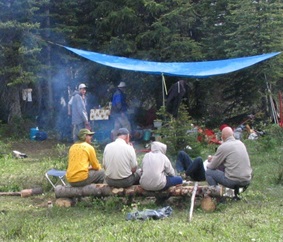
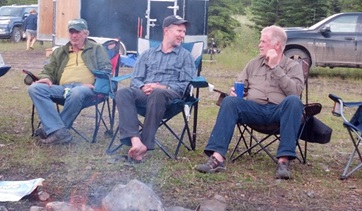
In the beginning people sat on logs around the campfire. Now, with transport, volunteers can relax in their own comfortable lawn/camp chairs while sharing their stories.
2009 – Logs around the campfire
Transport
2019 – Campchairs around the campfire
If one felt a need to wash/bath, a clean mountain lake or a pool in a cold stream was usually available (it was also a fridge).
Clear mountain lake – brrrrrrr……..
Cold streams make good refridgerators
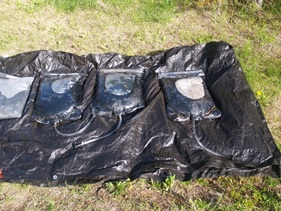
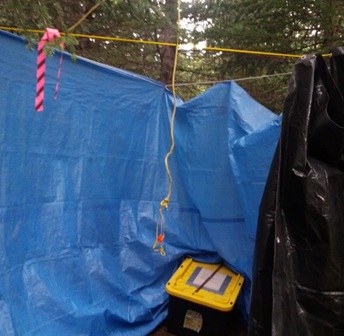
Now one can choose a warm shower (solar heated) in a private, tarp-walled, stall.
Solar heated shower bags
Shower
Since water is a necessity for drinking and food preparation, the camp was normally located near a stream enabling volunteers to haul water in barrels and pails. Now a solar panel charges a battery powered electric pump providing ‘running’ water almost to camp – still a work in progress.
A filtering system was also devised for drinking water.
Left – Bringing water to the campsite Right – 2022 – Water filtration system to go with the new water pump
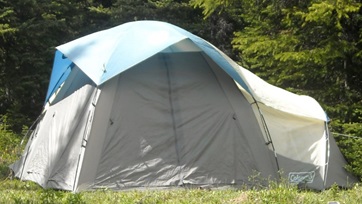
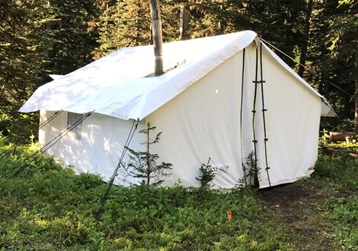
Volunteers slept on foamies in personal tents that were initially backpacked in. Now with ATV support some choose to sleep in larger tents allowing a person to stand to put on work clothes or bring a folding cot.
Large tent courtesy of ATV support
And cot also hauled in on the ATV
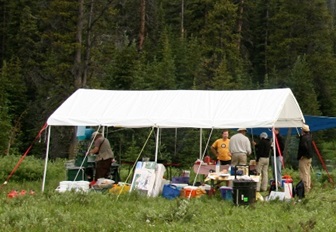
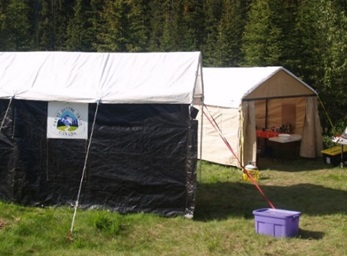
When it rained, campers huddled under tarps tied to the trees, next it was a car shelter, then it was two. Now people meet and dine comfortably in walled, heated, canvas outfitters tents.
2010 – Commons shelter
2011 – Commons shelter
2018 – Commons shelter
2022 – Commons shelter
From day one, feeding the Signature Trip crew well, was a priority. The cook planned menus, purchased the food which was organized and packed for shipping to the campsite.
Shopping for food (top); Organizing and packing food (bottom)
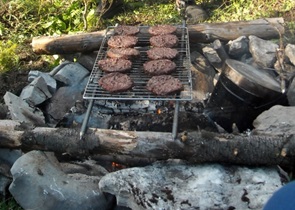
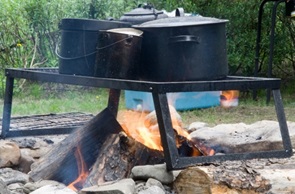
Initially cooking equipment was primitive but effective and efficient. The cook and helpers prepared the food to be cooked on Coleman stoves and the campfire.
2009 – Burgers grilled over the campfire
2009 – Cooking on the Coleman stove
Meals on the campfire
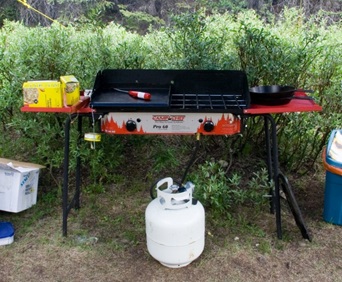
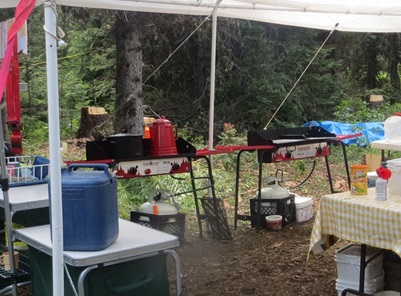
Over time, the Colemans (the stoves, not the people) were replaced with a heavy-duty propane camp stove, and then two.
2010 – The heavy-duty propane stove
2014 – Two heavy-duty propane stoves
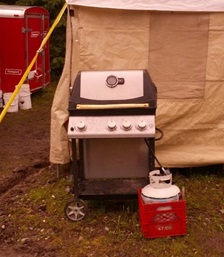
And then supplemented with a BBQ to keep the prepared food warm. One year, a beef roast was cooked in the BBQ.
Full blown propane barbeque
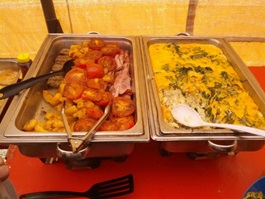
In two of the latter years, workers had the fortune of enjoying their meals created by a backcountry chef who used chaffing pans.
2021 – Meal prepared by the chef
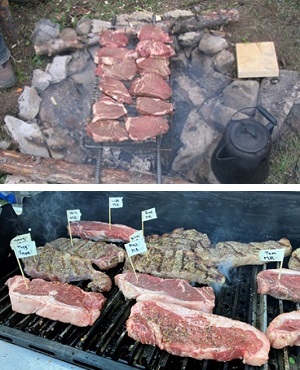
And of course, steaks by Lianne and Dan.
2009 – Yummy steaks over the fire (top) 2022 – Personalized steaks on the barbeque (bottom)
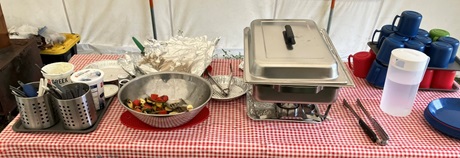
In the early days, food was eaten on ‘paper’ plates with whatever utensils each of us brought with us. Today, camp drink and food are provided in/on re-useable cups and plates along with real utensils.
2022 – Real plates, cups, forks, knives, etc.
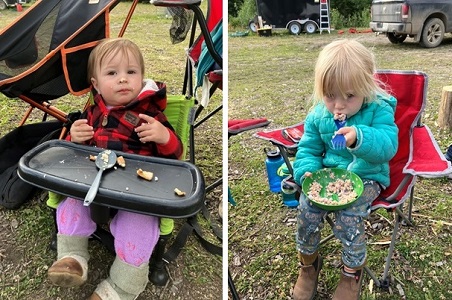
Some participants have more of a food ‘experience’.
Digging right in, Ah, to be young again…
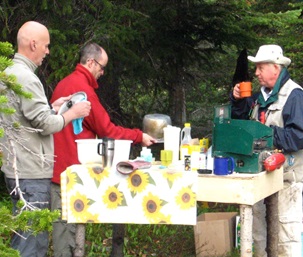
An outdoor portable/folding kitchen pantry provided a workspace, a storage area for pots and pans, and even a sink.
2010 – Portable outdoor kitchen
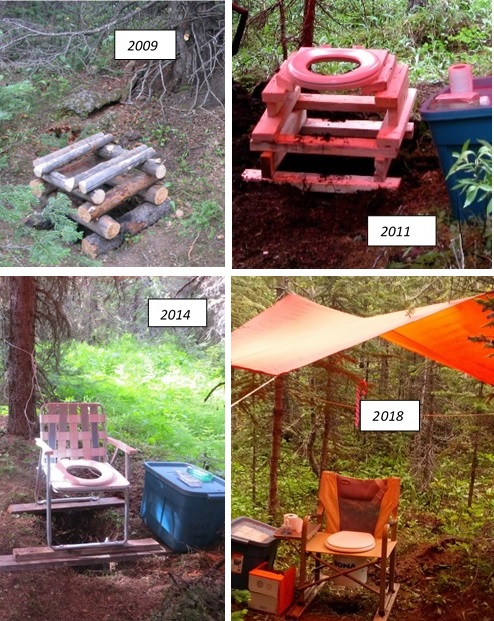
Of course, what goes in must come out. As the book (now in its 4th edition) says, people had to learn “How to Shit in the Woods”. Over the years, the latrine also advanced. From a cat hole with a strategically placed log, to several logs to give elevation, to 2 x 4’s appropriately and securely stacked topped by a toilet seat, to a luxury commode complete with a roof, and all with an open-air view. The latrine is a defining structure for the Signature Trip.
Commode evolution
It is a Learning Opportunity
Since its inception, the Signature Trip was designed to be a learning opportunity. The Trip, with its experienced leadership, offered knowledge and safety for people who may never have backpacked and camped in the bush overnight. Participants, with the guidance of mentors, experienced the rigours of setting-up and taking-down the camp. At the end of a hard day’s work, volunteers tasted the nutritious meals that they did not have to plan, purchase, or cook even though they helped prepare or cleaned up.
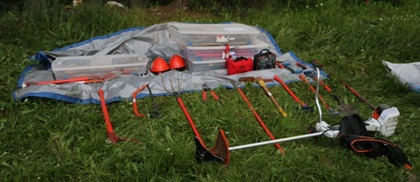
The Trip supplied unfamiliar tools along with the training and opportunity to learn their safe use, some even being taught how to use trail building and maintenance power tools. A few seized the opportunity to ‘scout’ the new Trail route.
2014 – Trail maintenance tools
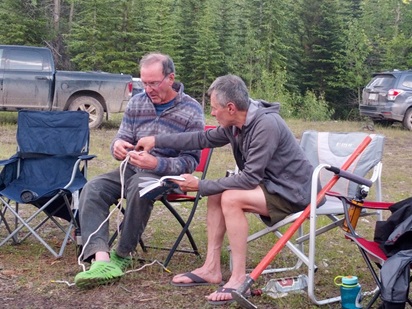
At the nightly campfire, after a traditional knot tying session, volunteers learned, from others, about their hiking adventures all over the world. As an experiment at the 2022 Signature Trip, participants also had the chance to discover where they were camping by interpreting a topographical map and competing against other teams to locate geocaches.
Knot tying session
It Builds Community
The Signature Trip typically attracts, due to the reasons above, participants that are ‘new’ to the Great Divide Trail. They may have heard of it, or even walked on parts of it. Most have little to no experience backpacking and camping in a remote location but are open to the possibilities.
Some volunteers return to the Signature Trip many times. Signature Trippers discover ‘community’; they find like-minded people with stories and experience to share, outdoor enthusiasts wanting to give back, adventurists who are looking for excitement and a challenge. Instructors and learners. Knowledge and skill. Practice and expertise.
Many first timers chose to re-live the exhilaration and come back on this or other types of GDTA trips thereby creating a community supporting each other to achieve a common vision.
It Has Tradition
Since 2004, what is now called the Signature Trip has been held almost every year, with some exceptions. The Signature Trip introduced many to the Great Divide Trail, its supporters and promotors, its community, its sponsors. The Signature Trip has become a tradition for the Great Divide Trail Association.
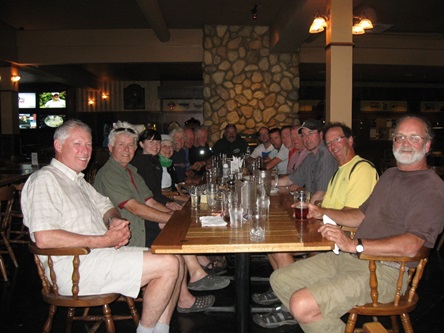
At the conclusion of the Signature Trip on the way back to Calgary it has become a ritual for the tired and dirty volunteers to convene at the Black Diamond Bar and Hotel pub to celebrate their Trip achievements.
2010 – Annual after party at Black Diamond Bar and Hotel pub
Is it a Brand?
If an organization’s ‘brand’ has these features: memorable, defining, unique, long lasting and mass recognition perhaps the Signature Trip has become the brand of the Great Divide Trail Association.
The trail building and maintenance committee, chaired by Dave Hockey, had a very busy and productive summer. Several trail crews answered the needs, both planned and unplanned, of Sections B, D, E, F and G. All told, it amounted to:
117 total individual trail work volunteers
6,950 volunteer hours building or maintaining trail
4 km of new trail built and
9 km of trail rebuilt or rerouted over
106 km of tail maintenance
3 brand new bridges
Trail crews kicked off the trail building season at the end of June, starting with the first of many trips to the High Rock Trail. There were exactly 7 trail building camps on the HRT, plus a special project to build the Allison Creek bridge, and one to do some additional clearing.
Allison Creek bridge.
Speaking of the High Rock Trail, this summer was the official opening of the High Rock. To celebrate the past 7 years of its creation, we held an event at Chinook Lake Recreation Area in Coleman Alberta. The Pass brewery in Blairmore even named a beer after the trail for the occasion – the High Rock Mango Blonde.
Trail Trip #3 crew hard at work on new switchbacks along the High Rock Trail.
GDTA President Doug Borthwick takes a break from his work on Trail Trip #6, to chat with long time GDTA volunteers, Deb and Jeremy as they hike the HRT.
In addition to all the trips to the High Rock Trail, we had many other successful trips.
First was the successful completion of the Collie Creek Bridge!
The Collie Creek bridge in Section D needed more enhancements.
The Oldman Bridge Building Trip where the crew built a brand new bridge on the Oldman River as well as trail clearing and maintenance to the new bridge site.
Brand new Oldman bridge.
The Colonel Creek Clearing Trip was in collaboration with BC Parks and Backcountry Horsemen of BC to clear the hundreds of deadfall that have resulted from a previous burn in Mount Robson Provincial Park.
The Jackpine Trip cleared 15 km of very tight bush, so that now hikers can enjoy a beautiful river walk through.
The Jackpine trail crew on the move.
David Thompson Heritage Trail Clearing which cleared a temporary route through two avalanche paths, clearing over 200 deadfall to Lambe Creek.
The David Thompson Heritage Trail, part of Section D, continues to cook up new challenges for GDTA trail crews. This new avalanche along the Blaeberry River took out trail.
A GDTA Trail Crew made an unplanned Trail Trip to clear a path (lower right) through the avalanche debris.
A collaboration trip with Friends of Jasper National Park worked on clearing bush in Maligne Valley with hand tools.
Maligne Valley Trip Crew starting out on the trail to camp. Left to right – Mark, Chris, Keiko, Andre, Al, and David.
Trip leader Tasha Shakotko had the below to share on her experience on trail building and clearing trips.
There’s something wonderful to be said for the amazing people who volunteer for the trail building and clearing trips. A group of people, likely meeting for the first time, coming together to venture into the backcountry. A common goal of wanting to give back, support the trail and it’s users; creating a bond and allowing friendships to form quickly. The excitement of starting out on trail, helping to make packs feel lighter and the miles to camp go quickly. Lively conversation filling the air as everyone gets to know each other a little better. Swapping stories about past volunteer trips and hiking adventures. The camaraderie deepening as everyone digs into the work, literally and figuratively. Working side by side – the satisfaction at the end of the day of a job well done shared equally by all. Yes, the trail improvements are the goal, but the reward is the time spent after the work is done. Reminiscing on the days efforts already starting around the circle of stoves as dinners are made. As the end of the trip and the return to normal life nears, the crew knows it lefts its mark on the trail – but as it always seems to do, the trail has also left its mark in the hearts of the volunteers. They’ll look back on their time with increasing fondness – allowing time to add a rosy tint to the mosquitoes, blisters, and dehydrated meals that filled their days.
Maligne Valley Trip Crew starting work on the trail. Left to right – Tasha, Mark, Al, Chris, Andre, Keiko, and David.
For this year’s Trail Building & Maintenance article we decided to let the volunteers tell in their own words about the trail crew trips. Over and above these reports there was one major “Scouting Trip” early in the spring, which besides setting the stage for all the High Rock trips, resulted in some major switchback building north from Window Mountain Lake. Also there were our first “Adopt a Trail” trips to test a new way to monitor and perform needed light maintenance on sections of the GDT. There is a separate article explaining them. In the meantime enjoy these volunteer trip reports and their stories.
Trips 1, 11, and 12
by Paul Jollymore
Three years ago my wife and I were enjoying a motorhome tour of Europe, when I thought to myself, that hiking in the mountains with a backpack held little appeal. Way too much effort. Upon our return home I realized that chocolate croissants were not on the recommended guidelines for daily breakfasts, and a demand for a fitness routine prompted me to the GDT. I’d completed Waterton to Sunshine in 2020, then the Rockwall to Saskatchewan River Crossing in 2021, and Jasper is planned for 2022. Joining the GDTA in 2020 was a great way to contribute to a trail I intended to use. Plans were in a flux in 2020 due to Covid but significant work was made along the High Rock Trail.
In 2021, the call for volunteers was disrupted over the winter but June approached and the preliminary bridge building project at Cairnes Creek – Trip 1, got the green light just in time. Enroute to the site, a road washout prevented progress so plan B prompted Dave, Doug, Rob, and I to head to the Atlas staging area north of Blairmore to do a little work on an alternate trail bypassing a section of road walk.
A second attempt at the Cairnes Creek bridge project – Trip 11, later in June brought Dave, Robert, Rob, David, Linnie, Doug, Tommy, and I out in an attempt to drag a generous size log across the creek as a suitable crossing. Our chainsaw winch and rigging wasn’t quite up to the task so a temporary crossing was left in place to accommodate foot traffic for the season. Our crew also headed to Lambe Creek crossing, clearing some trail along the way, and completed a repair job on the handrail at the bridge.
The third attempt – Trip 12, was made early in September when Dave, Rob, Robert, and I returned to Cairnes Creek with more rigging hardware. Robert provided us with a setup that managed to wrestle a 2.5 tonne log 40 feet across the creek without it even touching the water. Kudos to a well executed plan!
Each of these work parties required members to bring their own camping equipment and food. A common shelter area and cooking facilities were provided. Members had to come prepared to daypack to a worksite, pack a lunch, and bring suitable clothing for the day. While each of these work parties had a clear objective, the leads remained flexible when facing obstacles and reasonable alternatives were adopted as we went along. The work was strenuous but never overwhelming and the participants all expressed positive feedback on the experience.
I completed my GDT hike through the Cairnes Creek section in July and stopped for a break and encountered two other GDT hikers NOBO, and one hiker SOBO, as well as a family of four out for a dayhike in the 20 minutes I sat there. Andrew was the SOBO thru-hiker who completed the entire GDT in 20 days, aiming for 60 km per day and setting a record for the GDT’s Fastest Known Time in the process. The trail is only going to become more popular and it’s rewarding to know that our efforts contribute to the success and enjoyment of others.
Trip 2
by Melanie Sampson
The cool mountain air is crisp and the larch trees have turned, adding a splash of vibrant gold across the landscape along the Great Divide Trail. After an unusually hot and dry summer, the change in temperature is welcomed. During this transition of the seasons, I find myself reflecting on some of those long summer days; this year, I look back upon my incredible volunteer trail building and maintenance trip with the Great Divide Trail Association, and do so with much gratitude.
My name is Melanie and I have lived in the Calgary area for over a decade and have made our nearby Rocky Mountains a huge part of my life. I love to hike, trail run, crosscountry ski, bike, and am usually even keen for a swim in frigid glacier waters. I have built a career in aviation that allows me to travel all over the world, but when my feet are back on Canadian soil, I am typically mountain bound. With the slowdown of travel throughout the Covid-19 pandemic, I have been able to spend more time exploring our nearby trails, and found myself gravitating towards taking part in one of the GDTA’s trail building and maintenance trips. I was fortunate enough to sign up for Trip 2 along the High Rock Trail in the Crowsnest area. I had no prior experience with trail maintenance and was relying on the instruction and guidance of Trip 2’s crew leads, the positivity and encouragement of my crew mates, and my own eagerness to contribute to this ongoing project that is, quite frankly, remarkable.
Upon our crew coming together and meeting each other for the first time, we quickly bonded over our shared love of the trail, exploring wild places, and this magnificent thing called the Great Divide Trail. Together we shared stories from the trail; our favourite backcountry snacks and meals, how to make said meals from scratch and as close to gourmet as possible, swapped gear recommendations, and of course, shared tales of everyone’s previous wildlife encounters. While we all came from different walks of life, with varying degrees of experience building and maintaining trails, we came together naturally to dedicate a week of our time for the betterment of the trail so that others, like ourselves, could enjoy the beauty that lies within the Crowsnest area.
The days were extremely hot – topping out at 37°C! – but our team worked tirelessly, as we were all keen to make our trip leaders, Dave Hockey, Doug Borthwick, and Peter LaBastide proud. What our group was able to accomplish was incredible; the Scout Clearing team was able to flag and chainsaw nearly 2 km of new corridor south of camp, while the Tread team cleared blowdown and improved 3 km of trail north of camp, built new tread for 200m in the First Creek Valley, and 160m of new trail towards Racehorse Shoulder. Trip 2’s crew led the way and set the standard for the next six trail crews to follow, and the first 160m of trail built was used as an example for the next 5 km of trail up and over Racehorse Shoulder that saw more than 200 grateful hikers this summer. What an accomplishment!
I feel very honoured and grateful to have been able to spend a week with such fine individuals, who were all so inspiring and dedicated to maintaining, protecting and promoting the Great Divide Trail. I’d recommend taking part in a trail building trip to anyone, especially if our Rocky Mountains held a special place in their hearts; what a fulfilling experience! Thank you, Great Divide Trail Association for your incredible work; I’m already looking forward to next year!
Trip 3
by Emily Mayes
My name is Emily and I am an undergraduate student at McGill. I stumbled upon the GDTA website and signed up for this trail maintenance trip without knowing much about the Great Divide Trail or any idea of what to expect. I am so glad I did! I could not have asked for a better opportunity to learn about the trail building process and to spend some time in the mountains.
The trip was a resounding success. Most of us were first time volunteers with the Great Divide Trail and had little previous trail maintenance experience. We learned a lot from Doug, Dave, Peter, and the returning volunteers. I really can’t thank the trip leaders enough for sharing their knowledge and for their constant support and kindness. What our team might’ve lacked in trail building experience, we made up for with enthusiasm. It was energizing and motivating to be working alongside people with such passion for the mountains and the Great Divide Trail.
Trip 3 was a hot one. It had been +35C degrees for a week across most of Alberta and BC when we arrived at camp. It was slightly cooler in the mountains, but we were very much still in the midst of a heat wave every day of trail building. It didn’t slow us down too much though! Everyday we’d hike a very convenient 5 minutes from base camp to the start of our trail. From there we’d split into a few groups – scouters/chainsawers, trimmers, pulaskiers and then a finishing crew. Doug was great at noticing people’s predispositions for specific jobs and the work went very smoothly. We plugged along, breezing through sections of nice soft earth and taking our time on various other terrains permeated by stumps, roots and rocks and on intense side slopes. All said and done, we managed to complete about 1.3 km of beautiful 15 degree grade trail, nearly completely free of tripping hazards. (I will never be able to walk a trail and take it for granted again.) After four days of intense sunshine, the weather cooled down and we woke up to foggy skies instead of mountains on the final day. It rained on our way back down to the Atlas Staging Area and the rain was such a wonderful (and refreshing) conclusion to such an incredible week.
Trip 4
by Doug Borthwick
This trip saw the second of three youth groups help with building new trail. The Outdoor Council of Canada (OCC) on this outing, Crowsnest Bible Camp on the previous, and the Junior Forest Rangers on Trip 7, were major drivers to get this year’s work done up and over Racehorse Shoulder. Their youthful vigor and enthusiasm inspired other veteran trail builders immensely.
Trip 4 was the only one other than the Jackpine (Trip 10), which saw any significant rainfall during a very dry and hot summer. There were two nights of heavy rain and hail and the new tents and wood stove were very much appreciated.
This trip was the final one for the forward crew of trail blazers and chainsawers to finish their work, and at the end we said goodbye to Dave, Peter, Julien, and Jim. The tread crew built another hard earned 1.2 km of new trail.
The OCC having now become veterans, recruited an amazing cook to add to their camp. There were usually lots of leftovers, and Allistair was front and center showing the rest of the camp how to properly yogi an extra meal. I really don’t think we worked this crew hard enough as every morning at 5am, we had one ambitious volunteer who had to complete a 5 km trail run before breakfast. The last day the heat and dry weather returned and this crew was glad to dry out before heading home.
Trip 5
by Cody Hemmerling
I am Cody Hemmerling, a fourth year university student that took part in High Rock Trail (HRT) Trip 5. I signed up for the trip because I thought it was a great way to get involved with the GDT, and it provided an excellent opportunity to spend a longer amount of time in the bush. My experience was so much more than that. We had a small crew of seven, and while these people were complete strangers to me before the trip, by the end of the trip it was sad to leave them all, even the girl who wouldn’t shut up about Denny’s ?. It is really true that the outdoors brings people together.
I remember the first day Doug mentioned that the average volunteer makes about 20 metres of new trail in a day and thinking to myself “that seems like nothing, I bet I will do so much more than that”. Turns out Doug knew what he was talking about, trail building is hard work. We ended up finishing the switchbacks on the north side of Racehorse Shoulder before blazing a trail across Racehorse Shoulder, and beginning to build the trail coming down the south side towards Racehorse Road. We were fortunate enough to meet around 20 thru-hikers throughout our trip, all from different backgrounds, with a surprisingly high number of hikers hailing from Quebec.
Highlights of the trip included working atop the stunning Racehorse Shoulder, seeing mountain goats, and above all else the time spent in camp storytelling and hanging out with such an amazing group of people.
Trip 6
by Jeremy Bateson
In mid-July 2021, the GDTA ran Trip 6 to Cataract Creek on the Original GDT. Dave Higgins led a group of six people to install a new bridge over the creek and a smaller bridge across a nearby gulley. A helicopter and personnel from Alberta Parks dropped the 30 foot bridge logs across the creek as well as all the tools. The work crew hiked in 4 km from a nearby logging road access and set up tents around an old snowmobiling shack. Dave tried out a small motor bike and trailer to bring in extra load, but the trail proved to be too boggy. The bridge construction went well. As it turned out, six people was a very good group size for this work.
To start the creek work, the remains of the old bridge were cut away and cleared. After the sills were prepared, the logs’ ends were shifted into position. Dave brought a small chain fall with tripod to help shift the log ends. Once the work was done the tripod legs were used as additional materials. The group made an improvised winch with two 2×4’s to drag the logs to final position. The bulk of the bridge was complete and braced by the end of the second day. The bridge deck was finished with planks and an edge runner.
On day 3 the main group headed up the slope to bridge a large gulley. The gulley bridge was made with locally felled trees and was mainly complete by the end of that day.
On the final day the group walked back to the ridge north of Lost Creek, doing general trail maintenance as they went. They cleared some minor blowdown and trimmed back overgrowth.
The overall trip was a success and accomplished a lot of work with a small team. The use of a helicopter for select work was definitely a benefit.
It was a pleasure to see many hikers during the four work days. At least 10 people passed the crew and shared their insights with the crew.
Trip 7
by Kathleen Gallagher
Trip 7 began at a very civilized 11:30am at the Atlas Staging Area near Coleman in Crowsnest Pass. There I met my friends for the week: Jud, Christine, and Tom, a small but mighty crew. After a quick backtrack into town to pick up some washers to repair the hose, we were ready to drive up the gravel road to the snowmobile staging area where we would hit the trail. As we neared the parking area, out popped Doug on an ATV from the trees, smiling, waving and ready to embark on another successful week of trail building.
Unbeknownst to me, Doug would be towing our gear on the ATV, to the base camp for the week. Truly a missed opportunity since I had packed “backpacking” style. Next time I’m bringing a cot! A quick jaunt up the road and we arrived at our luxurious accommodations: two large common area tents, one for the food preparation/cooking and another for lounging, complete with a library of Great Divide books and a woodstove! We set up our individual tents and Doug gave us a tour of the camp, instructing each of us on our duties. The brave campers touched the live wire for the bear fence to ensure it was working, Christine and I did not. The bugs were crazy bad that first day but got better as the week went on (not sure if that is related to my tolerance or actual conditions)!
The first day as we walked to our worksite, Doug gave us tips and tricks, pointing out challenges and opportunities experienced by the previous groups. His teaching speaks for itself as we were spoiled by the beautiful trail that had been created by the volunteers before us, providing us with smooth sailing and a seamless hike to our starting point. On our commute to work we were fortunate enough to travel over a beautiful ridge, treated to magnificent views of Crowsnest Mountain, Seven Sisters Mountain, Mount Ward and the valley below. I had been a bit nervous about using the heavy and sharp tools required for trail building in the wild, but after a few minutes watching my skilled colleagues Jud and Tom, I felt up to the challenge! I’m glad I tried it out since trail creation is so rewarding! It felt awesome to demolish giant roots and also to look back at what we had achieved each day and think about how we were contributing to a little piece of history.
Day two and three were our main working days and our supervisor Doug was not too tyrannical. Some breaks were allowed and we even had lunch off! I would escape off to the beautiful ridge at lunch to catch some wind to cool off in the heat. An added bonus would be if the gusts blew the bugs away. All in all we had spectacular weather, not a drop of rain and I couldn’t have asked for anything better. Day four was a more lenient day, as it was the last and everyone was rather tired. Still, we built about 330 metres of trail through varied terrain, which we were happy with as only a four person group. 330 metres doesn’t sound like much on a 12,000 metre trail, but a journey of a thousand miles starts with a single step and that is 330 metres that wasn’t there before! I know that the folks that were going in straight lines up and down ridges with no gentle switchbacks to smooth the elevation appreciated it – they even brought us beer!
On our last night to close out the trip, Bartender Jud was generous with his supplies, and Tom and Doug shared countless stories from their past years of trail activities. Christine finally revealed her age to us and went from very impressive to legendary. Thank you to my wonderful companions of various backgrounds for coming together and sharing such a great week with me. I still smile every time I remember the sense of accomplishment and I can’t wait to get back out there next summer!
Trip 8
by Sebastian Kanally
The backcountry, an important refuge. The pristine mountain air fills you with life, the human noise was left behind hours and days ago, the backcountry is a palate cleanser, the backcountry is always there to remind us who we really are.
I am Sebastian Kanally, I live in Amherstburg, Ontario, and the mountains have called my name ever since I first laid eyes on them in 2018. I flew out to hike in the mountains this year- 2021, and I saw the email that the GDTA was looking for volunteers to help build sections of the Great Divide Trail, and I could not pass up the chance. I am a philosopher that is humbled by our natural world. This was an awesome opportunity for me to give some of my labour to the GDTA and meet a diverse group of people interested in volunteering and the backcountry.
Volunteering with the Great Divide Trail Association is a truly enriching experience. I had never done it before, and the experience exceeded my expectations as it was lots of fun. I enjoyed learning how trail is built and why trails are built the way they are. It is a great experience to look back at a day’s work, to see a trail there that was not there the day before. The hard work you put in that day to help build a trail so that others can see these beautiful places. My small amount of work comes together with hundreds of other volunteers to help hikers and equestrians of all abilities to experience the sublime nature of this landscape, in this small corner of the largest intact land biome left on earth.
To volunteer one’s time to go live in the backcountry, no cell service, just living a truly minimalist and essential life, limiting one’s footprint and working collectively to achieve a goal, is brilliant. The walk to work is stunning. The greatest part of the trail building experience for me was learning and developing a more intimate knowledge about this beautiful landscape. The intricate and symbiotic relationships between all the plants and animals, such as the White Bark Pine, the Larch and Spruce trees, the Clark’s Nutcracker, the Grizzlies, and how this is all being impacted by climate change and human activity. The ecological wholeness of this pristine environment demands our respect and work to protect. You can learn about it, but until you spend time and actually experience the landscape it is hard to appreciate how complex of an ecosystem this is.
If you are looking for a fun way to get out into the backcountry with a group of people, I would highly recommend trail building with the GDTA. In an era of climate changing our ecosystems, to meaningfully contribute and do so with an organization that values keeping the ecosystem intact, is priceless. Different people bound by their passion and appreciation of the Rocky Mountains made this a very fun and enjoyable experience. These are amazing people and friends I never would have met without volunteering. All these different demographics coming together truly speaks to the value of building trail and volunteering with the GDTA.
Trip 9
by Doug Borthwick
This trip almost never got off the ground and was very close to being cancelled. What had started as a promising crew size of nine had seen multiple last minute cancellations to come down to a final crew size of three with an added trip camp manager. A last second appeal brought out two fresh young recruits – Mark and Shawn, who worked back to back trips with no breaks. Combined with the Junior Forest Rangers working the changeover day, Jud leading, Stuart staying an extra changeover day, and three camp managers on Trips 7 and 8 wanting to help with the trail work, the three Canmorians who drove through the night to help for two critical days, and the dedicated work of all the original crew members, we were able to complete the remaining 1.5 km of trail south of Racehorse Shoulder. There cannot be enough thanks to this amazing group who were critical in finishing the final connection to Racehorse road.
The volunteers who worked Trip 9 were treated to a meeting with two of this year’s GDT legends. First was Andrew Cottrell who came flying at the group from the north during his record Fastest Known Time (FKT) 20 day hike of the GDT. This guy had time to stop and kibitz for a long time with the trail crew and in fact had to be encouraged to leave so they could get on with building more switchbacks. The second was Peter Whitehead, the 77 year-old who’s thru-hiking story inspired so many. Peter did not have any switchbacks to work with as he climbed determinedly from Racehorse road but he still had a laugh and a joke as he passed the trail crew trying desperately to get just a couple of extra meters done to help him on his way.
This crew amazingly finished their goal of attaining the road one full day early.
Trip 10
by Samuel Yamamoto (Prepper)
I’m someone relatively new to backpacking and thru-hiking, and I’m working my way up the GDT in sections over many summers. Last year I had the pleasure of doing Section A from Waterton to Crowsnest Pass and I was hooked! This summer I was going to embark on my own solo excursion on Sections B and C of the GDT until I saw the call for volunteers to help with trail maintenance in the Jackpine Valley. The dates lined up perfectly for me and being flown out by helicopter sealed the deal. I emailed Dan Durston right away to let him know I’m interested and available, and thankfully I was chosen to go. The journey started with about an 8.5 hour drive to McBride, BC from Lethbridge, followed by about another 45 minutes on a dirt road to where the helicopter would pick us up the next morning. Our crew consisted of nine of us from Alberta and BC.
During the first night, it gradually started raining and did not let up. The helicopter came in the rain after a search and rescue delay. We were dropped off just short of the peak of Big Shale hill where the peak was too socked in to be dropped off safely on it. It took the helicopter three trips to get all nine of us, our gear, and trail maintenance gear up. The trail maintenance gear included three brush saws, three hand saws, three large cutters, one chainsaw, and a ton of fuel in jerry cans to match. In addition we had several trail cameras to monitor trail traffic and wildlife that needed to be set up, and some cans of orange spray paint to “blaze” the trail. We started right away at the treeline on clearing the trail. At first we had three crews of two, a brush saw operator and another to follow, clearing the trail of cut debris. Chainsaw operator and spotter were together throughout the week as they were the only ones that had been trained and certified, and then a swamper in the back. We worked through the rain on day one with little glimmers of sun giving us a small reprieve from the rain.
We set up camp at the end of day one and I discovered most of my gear got wet through and through. My sleeping bag was about 50% wet and I was worried I was going to have major issues through the night. When I started warming up, even in my wet bag, I realized it was going to be okay. We also coincidentally had 7 X-Mid tents by Dan Durston on the trip! In the beginning of day two we had to ford our first of many river fords. By this time, the rain clouds had subsided and we welcomed the warm sunlight.
Day two was working mostly uphill toward another ridge where our pace quickened as we went back up the treeline and the foliage of the trail lightened up. We averaged about a kilometer an hour with our pace. We also changed to a lead team of three brush saws, sweep, followed by the chainsaw and spotter, then three in the rear sawing and cutting brush and trees as well as clearing debris. By this time we had found a groove that was working for all of us.
On the evening of day three, we shared our site and spent time with Fidget and Neon on their trans-American journey through South and North America. They were quite delightful and brought a fun energy to our camp.
There was a burn zone that we crossed through that was heavy work for the two-person chainsaw crew. They were well behind the pack clearing away fallen burned trees. We continued along the Jackpine River for the most part, clearing mostly thick willows. Our pace improved as each day went, and overall we were able to clear about 18 km of the trail.
The difference from the before and after our maintenance was enormous. Before, you couldn’t walk without getting whipped by willows or having to navigate through a thicket of trees or brush. After, you could hike comfortably without any foliage getting in your way.
As the end of the week came, we changed our focus to route finding through the marsh of the upper Jackpine Valley. Anyone who has traveled through this section knows what a nightmare this area is. We blazed trees through this section as an actual trail through the marsh is near impossible to establish. The established trail heading up to Blueberry Lake past the marsh was much more pleasant and the abundance of berries along the trails were a fantastic treat.
The views at the top of the pass were incredible and the weather treated us well. We descended to Blueberry Lake after six days. Most of our crew went ahead and finished to our cars while three stayed back and camped the night at Blueberry Lake.
The entire week was an amazing effort from nine different people who came together to make our GDT just a little better. It was tough, grueling work at times as the outdoors often are, but the rewards of not only spending a week in remote wilderness but making a tangible difference on the trail for years to come were worth every bit of the tough grueling work.
Thank you to all
Many thanks to all of this year’s volunteers! Thanks also go out to our supporterswhose generosity has greatly enhanced our trail building and maintenance capabilities, including Alberta Equestrian Federation, Alberta Environment and Park, Alberta Culture and Status of Women, Alberta Forest & Garden, Stihl, and Columbia Basin Trust.
2020 was another great year for trail building and maintenance on the Great Divide Trail. Much thanks has to be given to all those on the GDTA Trail Building and Maintenance Committee(TMBC) who put in an extraordinary amount of work behind the scenes just to be able to safely put together any trips. Planning was ahead of schedule and most of the planned work trips were full by February. Then the country went into lockdown to protect citizens from a worldwide pandemic. It was at this point that all planning was put on hold and work trips were cancelled. There was a suggestion that all work parties for 2020 should remain cancelled. The TBMC worked diligently to come up with a plan to safely have at least a few work parties to get a minimal amount of work and maintenance done. After many hours of planning and strategizing they came up with a plan that would work to enable small groups to at least be able to do a little work on the GDT. In the end, what these small work groups accomplished was amazing. All told there were seven planned, advertised trips and two more unadvertised trips. A total of 57volunteers participated with many helping out on multiple work crews.
David Thompson Heritage Trail Trip – Cairnes and Lambe Creek Bridges:
It started in late June when a small unit of three volunteers gathered at Cairnes Creek. The goal was to put a temporary bridge across Cairnes Creek (the double log crossing that had sufficed for the last four years had broken over the winter), re–scout the first km of the David Thompson Heritage Trail (which still has flooding problems),perform a minor repair, and strengthen the new hand rail on the Lambe Creek bridge.
The first day the crew cut the old logs and used some reclaimed lumber to make a stable crossing.
Unfortunately two weeks later the creek flooded again and washed this temporary bridge away.
The second day saw the crew make their way eight km up to Lambe Creek to reinforce the handrail on the LambeCreek bridge. Along the way they encountered many winter downed trees across the trail which had to be cut out. They spent a few hours at LambeCreek performing a small repair to the rail and reinforcing it with the two by fours which they had carried in by hand.
On the walk back the crew took notes of the flooded sections still occurring in the first km for future trips.
High Rock Trail – Trip #1
The GDTA official trips started June 24 with a volunteer crew of eight plus another crew of eight from the Outdoor Council of Canada. To safely have this large group, two separate camps had to be set up. Work on section L of the High Rock Trail (HRT) was started with hopes that at the end of four work crews, 700 meters of new tread would be built. This was all that had been cleared with chainsaws previously, and without a bird survey the crews could not chainsaw further up the ridge. Luck would have it that in the Trip #1 crew there was a biologist who would be able to survey the trail all the way to the ridge top. Now a chainsaw crew was able to further clear the rest of the route. What Trip #1 crew lacked in experience, they more than made up for with great enthusiasm, and when the smoke cleared they had built an incredible 1.1 km of new trail.
High Rock Trail – Trip #2
Trip #2 started with wet, miserable weather that would continue the whole five days. This crew dealt with some of the most consistent wet, muddy conditions ever experienced building the HRT. As well, they ran into some major endangered WhitebarkPine stands for which tread had to be gently built around. Trip #2’s tough crew of six built out another incredible 400 meters of new trail.
High Rock Trail – Trip #3
The conditions were not looking too promising for the Trip #3 crew either, as they had to contend with continuing rain for the first day and a half. Thankfully it soon cleared up and became sunny and pleasant for the remainder of their work party. The conditions were better but the terrain proved extremely rough with steep sidehill and lots of roots and rocks to contend with. This very experienced crew built some of the smoothest nicest tread ever, and by the end of their time they had hacked out another 400 meters of new trail.
High Rock Trail – Trips #4, #5, and #6
Trips #4, #5, and #6 were the last scheduled ones for the HRT for 2020, and they mostly ran concurrently. Trip #4 was camped just 1 km off the Atlas Road in section U, and with the help of a crew of Junior Forest Rangers for a day,they were able to finish tread on section U and V, and with the help of the HRT Walking Crew built a set of tricky switchbacks on section W. As well, they built a bridge over a small creek in section U. All in all another fantastic 1 km of tread was completed by this amazing mostly rookie crew.
Trip #5’screw remained camped at the start of section L, and the first day had a really tough 100 meters to complete on a super steep exposed side slope. This was slow tedious work. The second day things got a little easier through a fairly flat forest, and then they broke onto Hail Ridge which was easy – mostly just scratching out a route. Meanwhile a small chainsaw crew had worked down the other side of the ridge into some new regenerated forest. This was two days of really rough chainsaw and brusher work to get a path worked through these close growing small trees.
During the evening of the third night the Trip #6 Walking Crew wandered into Trip #5’s camp. The previous three days for them had been spent marking and mapping trail from the southern start at Allison Creek. Along the way they had built tread, met up and helped Trip #4 crew build switchbacks on section W, and cleared and marked the trail allthe way. This young enthusiastic crew of former GDT thru hikers worked two more days marking and clearing the rest of the High Rock Trail route so that there would be a possibility of making it walkable soon.
Large deadfall cleared by hand
Meanwhile Trip #5 had crossed the ridge, and by utilizing an old horse packers trail,they were making rapid progress to the end of Section J. The last day saw them work into the regenerated forest area where the forward chainsaw crew was still hacking away. All in all, this incredible crew had built another 1.2 km of trail. They did this with the help of an easy ridge and horse packers trail in the middle.
So the High Rock Trips were supposedly done, resulting in an incredible 4 km of new tread built, as well as being completely cleared, marked, and mapped.
Lost Creek Trip
Late July saw the largest GDTA contingent of twelve working in two teams at Lost Creek. Team #1 worked to complete work started last year rebuilding the tread on the Lost Creek Trail. Team #2 was tasked with building a new bridge over Lost Creek. The weather cooperated and both teams completed their tasks to extremely high standards.
New Lost Creek bridge
High Rock Trail – Trip #7
When the Walking Crew’s report came in, it was felt that the entire HRT was “almost Walkable”. The only really tricky part was a 1 km section at the top of Section E which was deemed too hard to follow. A decision was made to see if it was possible to get a last minute volunteer crew put together to take care of the impassible kilometer. The call went out and five veterans and one rookie answered.
The newly made up High Rock crew was designated as Trip #7, and included five fairly experienced trail builders and one rookie. They worked during the hottest period of the summer. This enthusiastic crew right away had some decision making as the marked trail was confusing. Working on some difficult side slope off the bat, they had to contend with stacking some switchbacks where none looked possible. Slowly, for the first three days they built the new tread. Each day had a bonus as GDT thru hikers started passing them, showing that the High Rock Trail was being utilized.The last day was the most difficult terrain as it hadn’t been properly cleared or brushed. Building good tread on this last bit would normally take a fairly large crew one full trip. The issue was that this was the critical area that hikers could not follow unless there was some sort of a path. Digging deep, the five remaining trail builders determined they could at least make something followable and semi-walkable. What they accomplished was an extraordinary, very walkable path.Another 1 km of tread had been built and on July 24, the new High Rock Trail officially opened for business!
Sunset on the GDTA basecamp
Cairnes Creek Bridge Trip (yes, again…)
Meanwhile an informal crew of six or so had come together mid July to cobble together another temporary crossing of troublesome Cairnes Creek, so that this year’s hikers might have a safe crossing.
New temporary Cairnes Creek bridge
Late Season Scouting Trips
This should have been the end of the story except that there was still work to do so that preparations could be made for work in 2021. In mid September, a small crew got together again at Cairnes Creek to survey for a new permanent bridge, come up with solutions to mitigate future flooding on the first 1 km of the DTHT, and survey the new possible future route across Amiskwi Ridge and Collie Creek on the eastside of the Blaeberry River.
Surveying for a new bridge over Cairnes Creek
Additionally, scouting has taken place in early October for next year’s work on the HRT sections M,N, and O. Lots to look forward to!
Thank you to all
Many thanks to all of this year’s trail building crews, as well as the people behind the scenes putting everything together.
Thanks also go out to our sponsors and partnerswhose generosity has greatly enhanced our trail building and maintenance capabilities – They include Alberta Equestrian Federation, Alberta Environment and Park, BC Rec Sites and Trails, The North Face, MEC, Teck, Stihl, and Columbia Basin Trust.
2019 was a very busy year for the GDTA, with more scouting, trail building and maintenance trips than ever before. A huge amount was accomplished thanks to the large number of hard-working and dedicated volunteers. Key accomplishments in 2019:
The wettest and coolest summer in the Rockies in decades, but no wildfires!
135 volunteers participated in 12 trail building and/or maintenance trips and 2 scouting trips – the most volunteers and total trips ever in one season!
50 return volunteers from previous trips
54 first-time volunteers, including:
2 instructors and 10 students from the Wild Rockies Field Institute in Montana
2 troop leaders and 8 Junior Forest Rangers from Calgary
4 km of new trail cleared and/or built on the High Rock Trail
13 km of the historic David Thompson Heritage Trail restored + 1 bridge completed
6 km of the Maligne Pass Trail cleared in Jasper National Park
1 km re-built on the Original GDT
June Scouting
The season started with the usual spring scouting trip which we like to hold a week or two before the first work trip, which meant this year’s scouting trip was earlier than usual. Thankfully on our drive in, the scouting team only encountered snow on one short section of the Atlas Road. But this still took most of the day to dig and push our way though. The snow increased higher up and we could not drive all the way up to the intended camp spot so we improvised and set up camp at “Winch Creek” just before dark. The next day scouting higher up was not possible due to 1 metre of snow, so we concentrated lower down and spent a good amount of time scouting future work camp locations. The time spent on fine tuning the route was well worth it.
Late Spring in the Canadian Rockies
Trips #1-3 – High Rock Trail, June 13 to 27
By June 13, snow was no longer an issue, amazing what two weeks does. Day 1 was warm and sunny. Equipment and supplies for our base camp for Trips 1-3 was shuttled in to First Creek Road via ATV while the crews walked in on foot. The weather started great but we had some unusually cold and rainy days, one day of snow and one day with some intense lightning. Overall things still worked out, but we shortened some work days as the cold and rain drained people’s energy and made the terrain very slippery. Even though the weather didn’t always cooperate, we had a lot of experienced volunteers on the first three trips which allowed us to make good progress.
GDTA Volunteers (in the snow)
These first three trips involved building trail tread up a steep slope as well as brushing and chainsaw work. Over the 2 weeks, we completed 1.4 km of new tread, completing all brushing and chainsaw work in the area. This year each trip had volunteers responsible for leading duties like latrine, firewood, food storage, etc. and it worked out better than we could ever have imagined. Volunteers really took ownership of their responsibilities and it reduced the demand on the trip leader, resulting in a very well run and enjoyable camp for all.
Tread building (on steep slope)
Trips #4-7 – High Rock Trail, June 27 to July 19
These trips had a slightly different makeup with most of the crews being first time GDTA volunteers. Enthusiasm was high as trip leaders taught new volunteers safety procedures and trail construction techniques as tread building was the focus of these trips. As always, there was a significant focus on safety including our new and improved tailgate meetings to begin each day. Things worked out very well even though more rain and cold weather continued throughout. As tread building progressed on Section G, the slope got steeper and thus more attention to detail was needed to make the proper tread width safely on the difficult terrain. Volunteers worked hard in some nasty weather as high winds also become a factor both at the work site and in camp.
Tread building (through the forest)
A group from Montana’s Wild Rockies Field Institute joined us for a few days and they came in with youthful energy and amazing work ethic. With their help, we finished the tread to the top of Section G, achieving one of our objectives for these trips.
Wild Rockies Field Institute Trail Crew
On July 9, our base camp was moved to a new location on the Atlas Road near the access to Window Mountain Lake. This was a learning experience as it was our first time moving camp between trips, involving a lot of work by only a few volunteers. The new base camp featured some serious ingenuity, where we built a solar-powered water pump to get water from the nearby creek which was down a steep ravine. The new camp was used for the next 4 trips including the Signature Trip.
Tread building (through an old clearcut)
Weather continued to be a challenge with more rain and unseasonably cold temperatures. But our volunteers persevered and built tread on Sections Q and S which thankfully featured much gentler slopes than Section G making trail construction easier and faster. During these 3 weeks, we completed an additional 1.4 km of new tread, connecting several sections of the High Rock Trail.
Trip #8 – High Rock Trail Signature Trip, July 19-23
This trip had maybe the most experienced crew ever with all but one of the 20 volunteers having had participated on at least one previous trail building or maintenance trip, including 5 of the Original GDT scouting crew from 1974.
Original GDT’ers (left to right): Mary Jane Kreisel, Cliff White, Dave Higgins, Jenny Feick, Dave Zevick
Many stories of the early days of the GDT were shared each night around the campfire, including a song or two.
Songs around the campfire
As always on Signature Trips, all food is provided and meals were prepared by Marty, our experienced head chef extraordinaire and his assistant Mary Jane.
Signature Trip food
Other than one day of rain, the weather finally improved allowing the crew to work under blue skies for most of the trip. Again, a renewed attention to safety was paramount and extra time was taken to review safety procedures and practices at the start of each work day. The goal of the Signature Trip was to start building trail in Section U, south of Window Mountain Lake. The section featured some fun but still challenging terrain to build trail – wet valley bottom down low and rocky steep slopes up high. In total 1.2 km of new tread was built on Section U.
Building switchbacks up the hillside
The lower section of trail was very wet and necessitated some creative trail building to divert water from the trail and mitigate some very muddy conditions. On the last day of the trip, some volunteers hiked up to the ridge above Section U with spectacular views of Crowsnest Peak and Pass, while a few others hiked to Window Mountain Lake for a quick swim before returning to camp with a deep sense of satisfaction of time well spent on the Great Divide.
Window Mountain Lake
Special thanks to the North Face for outfitting all of our Signature Trip volunteers with cozy fleece sweaters!
GDTA Signature Trip Crew in their North Face gear
Trip #9 – “Original GDT” Lost Creek, August 2 to 6
The purpose of this trip was to relocate a section of the “Original GDT” near Lost Creek that had been destroyed in the floods of 2013. A crew of 10 volunteers set out to re-locate the trail to a good dry route through the forest.
GDTA Volunteers (in the sunshine)
The crew scouted the area thoroughly in order to flag the optimal route avoiding the wet, brushy meadows. The crew also performed maintenance on the trail toward Cataract Plateau, including much needed chainsaw work. Afterwards everyone enjoyed the spectacular views from the plateau.
Cataract Plateau
The next three days were spent building two bridges, clearing deadfall, and brushing the old trail. Hot sunny weather (unusual for this summer!) was a challenge but volunteers decided it was much better than cold and rain. A few hundred metres of new tread was completed through the meadow. The last day was spent scouting trail up from the bridge site and assessing trees for a future bridge, preparing for completion of the necessary work to re-route the trail in 2020. It was a great few days of work including a bonus of two thru-hikers arriving in camp one evening – always a highlight.
Bridge building
Trip #10 – Maligne Pass Trail, August 10 & 11
Our second annual work trip on Maligne Pass/Trapper Creek Trail in partnership with the Jasper Trails Alliance was a huge success. A cumulative 126 hours from 21 volunteers created a corridor through a field of impenetrable willows, sightlines cleared a densely vegetated area between the willow field and Trapper Creek Campground and all small deadfall on the incoming trail was removed.
Trip #11 concurrent with Trip #12 – David Thompson Heritage Trail, August 29 to September 2
The 2019 work was essentially a continuation of work that began in 2018 with clearing and rehabilitation of the first 8 km of the David Thompson Heritage Trail from its trailhead at Cairnes Creek (end of the Blaeberry FSR) to Lambe Creek. In 2019 our objectives were:
1) Finish this work to the Banff National Park boundary at Howse Pass, a further distance of 5km.
Howse Pass
2) Stabilize and improve (by installation of a handrail, stiffeners and wire mesh) the 2-log bridge over Lambe Creek that had been built in late 2018.
Lambe Creek bridge
3) Make other improvements and enhancements to the first 8 km section, rebuilding, restoring, and reinforcing the trail tread.
Restored trail next to the Blaeberry River
All of the above objectives were met successfully. The entire 13-km length of the David Thompson Heritage Trail is now completely restored and suitable for foot travel.
Thank you! – Special thanks go out to all of our hard-working volunteers who built, maintained or mapped the trail this year, and everyone who spent countless hours over the winter months getting official authorizations, planning and making sure these trips went smoothly. Well done!
And thanks to our sponsors and partners whose generous donations and support were a huge part of our successful trail work in 2019: MEC, Teck, The North Face, Alberta Equestrian Federation, Columbia Basin Trust, Stihl, Alberta Environment and Parks, Recreation Sites and Trails BC, and the Jasper Trails Alliance.