Author: jocelynwood

  • Pathfinder Newsletter – Summer 2016

    Pathfinder Newsletter – Summer 2016

    Check out the Great Divide Trail Association’s latest edition of Pathfinder including:

    • Signature Trip Update;
    • Sponsor Spotlight;
    • Trail Tales;
    • Oh The Peaks You Will See;
    • Best of the GDT;
    • Trail & Road Conditions;
    • Upcoming Events;
    • Trail Opportunity;
    • and more!

    You can view the latest edition of Pathfinder here.

    summernewsletter

  • An Origin Story

    An Origin Story

    By Christine Smith

    My love of the Great Divide Trail happened by chance. It was the winter of 2010 and Rich, my partner in all things great, bought me a book for Christmas. It was Emerson Sanford and Janice Sanford Beck’s Life of the Trail 1 Historic Hikes In Eastern Banff National Park. It was a habit we had that when we went to bed Rich would read to me.  I would lay there feeling the stresses of the day melting away, imagining what it would be like to hike the trails mentioned in the books, the vistas I would see, the mountains towering over me, the glaciers, the trees and wild flowers.

    I would witness the birth of rivers at their headwaters as if I was the first one to discover them. Not to mention the wildlife! Perhaps encounters with the rarely seen caribou or mighty grizzly? I could almost feel the sun on my face, smell the fresh air and experience the complete silence enveloping me. Imagine, no city noise, no people, no day-to-day job stresses. I wondered what it would feel like to be truly free. What would it be like to have no  commitments, no responsibility to anyone but myself? What would it be like to walk the face of this earth like the early explorers to this area of the Canadian Rockies?

    Once we finished the book, these dreams might have gently faded, but it just so happened that in the back of this book were other suggested readings, one of which was Dustin Lynx’s Hiking Canada’s Great Divide Trail. The words jumped out at me from the page, “Trekking the Continental divide from the US border to Kakwa Lake is a demanding adventure”. I hastily purchased the book at MEC and looked forward to a good read. The book it turned out was a trail guide consisting of detailed maps, trail descriptions, mileages, campground locations. “Hey!” I thought, “It looks like it is all laid out here for us”. It looked like the beginning of a plan.

    Once we read the trail guide the conversation went something like this:
    Me: That trail looks amazing.
    Rich: Yes, It does.
    Me: I would like to do that trail.
    Rich: Me too.
    Me: We would have to quit our jobs.
    Rich: Yes, we would.
    Me: Want to?
    Rich: Sure.
     

    It was the beginning of a great adventure culminating in our first attempted thru hike on Canada’s Great Divide Trail in 2012 and our second in 2015. Looking back now, I realize I had formulated a very romantic idea in my mind of what hiking this trail would be like. In reality, I can’t remember once singing “Climb Ev’ry Mountain” while twirling around on any of the mountain passes. However, for the most part all my expectations were met. I did see all the beauty of nature from the hanging glaciers on the Rockwall trail to the beautiful blue waters of Michelle Lakes. We pitched our tent in the midst of a field of wildflowers awaking to their bobbing heads. We stood on the highest pass of the Great Divide Trail in total silence where I gazed above the mountain tops, the valleys, and trees and I felt at that moment completely happy I was there; just being and existing in that moment. I even got to have that close up experience with a few grizzly bears as well. Perhaps too close.

    Rich and I continue to plan new adventures. There are always new areas to explore and new challenges to meet on the GDT. All I know is when the Rockies are in view they call to me, “Come home!”

  • Oh The Peaks You Will See: Veteran Peaks – Part 2

    Oh The Peaks You Will See: Veteran Peaks – Part 2

    By Jen Peddlesden

    The idea for this historical look into mountains named for WWI people and events was inspired by a book given to me by friends, Canmore and Kananaskis History Explorer by Ernie Lakusta. The centenary of WWI is an opportunity to look at this world changing event, and no doubt those people who were exploring our Rockies felt that its monumental effect on the world should be memorialized in stone — thus the many Kananaskis peaks of the British Military Group.  North of Mount Indefatigable, discussed in the Spring Pathfinder, along The Great Divide Trail you will see Mount Sir Douglas and Mount Birdwood, our Veteran Peaks discussed in this Summer edition.

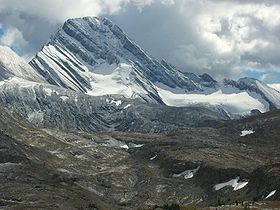
    Mount Sir Douglas, in the Spray Range, was named for Sir Douglas Haig.  This imposing peak, which you will encounter between the Palliser and North Kananaskis passes, is 3411 m. Haig, commander of the British forces in France from 1915 to 1918, was the 1st Earl Haig of Bemersyde and the son of a wealthy Edinburgh distiller—his early advancement a result of patronage, and marriage to Queen Victoria’s maid of honour also helped! This mountain and Haig Glacier are named for a man who said ‘every position must be held to the last man…each one of us must fight to the end.’ And so they did. Under his command at the Battle of the Somme, 620,000 British and French men lost their lives. Haig’s ‘attack at all costs’ mentality was criticized by many, even by the British Prime Minister at the time, Lloyd-George.

    280px-Mt_sir_douglas
    Mount Sir Douglas – Photo by Wiki

    The first ascent of Mount Sir Douglas was in 1919 when Dr. J W Hickson hired Ed Feuz, a local Swiss guide, to join him in the ascent. They navigated to the twin summits handily by 5pm and left two cairns on each summit which can still be seen from Palliser Pass today.  At the same time, another party, lead by Swiss guide Rudolph Aemmer, and including a colleague of Feuz’s, Val Fynn, was in the area hoping to be first to the top. Passing by the Aemmer/Fynn camp next day, Feuz commented to Fynn’s wife “I wonder why they didn’t go our way, where we went yesterday?” Feuz responded to the dumbfounded wife with a cheeky “Don’t worry, that ridge Rudolph and your husband are on will make a fine second ascent.”

    Mt Birdwood WIlliam Marler 2006
    Mount Birchwood – Photo by William Marler 2006

    Had Dr. Hickson and Feuz looked north from the twin summits, they would have seen a spectacular looking mountain perched along the Spray River Valley: Mount Birdwood. Ah, finally a name that conjures the picturesque and natural; however, it was named for Sir William Riddell Birdwood. Known as ‘Birdy,’ this British commander lead the Australian and New Zealand corps in WWI. The first ascent of the 3097 m peak was in July 1922 and led by a familiar name, Rudolph Aemmer. Near the top they reached a chimney with smooth sides and few handholds. After 7 ½ hours, Rudolph summited Mount Birdwood by standing on a fellow adventurers back, perching on his shoulders, and finally reaching the top with a supporting shove. Some times you just need that extra friendly push to go the distance on the Great Divide Trail!

  • The Best of the GDT

    By Brad Vaillancourt & Doug Borthwick

    Don’t have time to hike the entire GDT and looking for the best day, weekend or week on the Great Divide that isn’t completely booked up (like the Rockwall and Skyline trails)? Check out these outstanding trails that showcase the Best of the GDT! (Note these are all one-way trails that begin and end at different trailheads so two vehicles or a shuttle will be required.)

    DAY HIKE: Peaks, Lakes and Waterfalls – The Carthew-Alderson Trail in Waterton Lakes National ParkCarthew
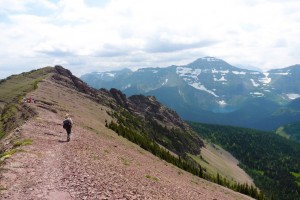
    With breathtaking vistas, crystal clear lakes, cascading waterfalls and wildlife viewing opportunities, on the reward-for-effort scale it doesn’t get much better than this. Beginning on the shores of stunning Cameron Lake, the Carthew-Alderson trail quickly starts gaining elevation on long, sweeping switchbacks. Catch your breath at Summit Lake at kilometre 4, before continuing the climb into the alpine to the trail’s high point at Carthew Summit (2310 m) at kilometre 7.5. Take an extended break to enjoy the spectacular views in every direction including the towering peaks of Glacier National Park to the south in Montana.

    From Carthew Summit the trail descends to the east, where in the far distance you can see the Rocky Mountains suddenly end and the flat plains of the prairies begin. As you descend towards Carthew Lakes on the red rock slopes of Mount Alderson you might feel more like you are walking on Mars. Continue around upper Carthew Lake where snow patches can linger late into the summer, and keep your eyes open for Rocky Mountain Bighorn Sheep and Grizzly Bear as you are walking through their backyard.

    Descend the steep trail from lower Carthew Lake past the cascading outflow from the lake, down a couple switchbacks to Alderson Lake. A short side trail takes you to the shores of this emerald lake set in a huge natural amphitheatre surrounded by mountain peaks on all sides. This is the site of the inviting Alderson Lake campground. 6.5 kilometres from Alderson Lake, the trail ends at Cameron Falls on the western edge of Waterton townsite (1280 m).

    Trip-planning:

    • Trailhead directions: Take the hiker’s shuttle (free in 2016) from Waterton townsite to Cameron Lake and begin the hike at the Carthew-Alderson trailhead (1660 m).
    • Permits: Not required for a day hike.
    • Distance: 20 km
    • Difficulty: Moderate. The trail is excellent but the elevation gain is significant.
    • Elevation gain: 650 m

     WEEKEND HIKE: The Summit of the Great Divide – David Thompson Highway to Pinto LakeMichele
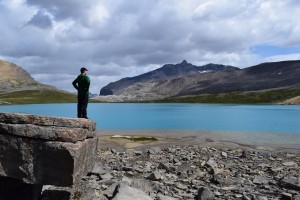
    Begin at the Owen Creek trailhead just east of the Banff National Park gate on the David Thompson Highway (Highway 11). After a short climb you will come to an incredible slot canyon. Owen Creek has carved a deep ravine that you can straddle and view cascading 30 metres below your feet. A short walk farther will take you back to the banks of the now more placid creek where you can picnic and get great views of the Wilson Icefield.

    Continue on up the creek bed, scrambling over boulders and small waterfalls, to the first of three high passes. Cross-country travel across a scree slope brings you to Michele Lakes. Before you head down to the lake, climb the 30 metre berm to the cliffs above the lakes to marvel at Michele Lakes deep aquamarine beauty from high above. Bring a fishing pole to try your luck for the elusive California Golden Trout for which these lakes are renowned.

    After a break lakeside, climb to the highest point on the GDT at 2590 metres, where there is a rumour of a bottle of fine Canadian rye whiskey hidden somewhere in the cairn at the top of the lofty pass. Sign the summit trail register and then head down the steep scree to Waterfalls Creek where there is a good campsite before attempting to find the hidden route up the next high pass (look for orange blazes).

    From the third pass, it’s an easy trek on good trail down to Pinto Lake. The main campground on Pinto Lake is on the north shore but the best campground is on the south-east shore, where in the morning you can enjoy your coffee watching the sun melt the mist off this almost always serene shoreline. If you are lucky you may find the geo cache from the Calgary Olympics. This was cached over 20 years ago and contains some really neat stuff. It’s near the shoreline at the base of a giant spruce which is broken and burnt from a lightning strike a couple of years ago. Finish the weekend by heading over Sunset Pass back into Banff National Park to the Sunset Pass trailhead on the Icefields Parkway (Highway 93).

    Trip-planning:

    • Trailhead directions: The Owen Creek trailhead is 6 kilometres east of Saskatchewan River Crossing on the David Thompson Highway, 80 kilometres north of Lake Louise. The Sunset Pass trailhead is 16 km north of Saskatchewan River Crossing on the Icefields Parkway.
    • Permits: A National Park Wilderness Pass is required if you plan to camp in Banff National Park (on the Owen Creek trail or the Sunset Pass trail)
    • Distance: 40 km
    • Difficulty: Difficult. Portions of this route involve cross-country travel (i.e. no trail) so good route-finding skills, and a map and a compass are required.
    • Elevation gain: This route climbs 4 high passes with elevation gains of 1065 m, 240 m, 310 m, and 415 m.

    BONUS: This trip can be extended by continuing down the Cline River from Pinto Lake to Cataract Creek in the Whitegoat Wilderness. Follow the primitive Cataract Creek trail to its headwaters, passing some ancient pictographs along the way. A steep, cross-country climb will bring you to the top of Cataract Pass where you will cross into Jasper National Park and be treated to amazing 360 degree views of a massive col surrounded by glaciers and waterfalls. Descend from the pass and follow the Brazeau River to Nigel Pass, where a trail junction leads to the trailhead parking lot on the Icefields Parkway. Additional distance: 40 km and one additional pass with an elevation gain of 740 m.

    WEEK-LONG HIKE: Meadows and the Matterhorn (of the Canadian Rockies) – Mount Shark trailhead to Sunshine Village via Mount AssiniboineAssini
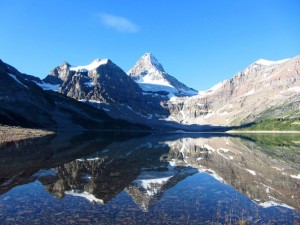
    This trail crosses the continental divide four times and is a wilderness highlight reel of crystal clear alpine lakes, wildflower meadows, and endless views, with the iconic beacon of Mount Assiniboine towering above.

    Start from the Mount Shark trailhead (1700 m) and hike 6 kilometres on the Watridge Lake trail to reach the GDT, just inside the Banff National Park eastern boundary in the shadow of towering Cone Mountain. The trail follows Bryant Creek upstream, beginning mostly in the forest but the views improve farther up the valley as the trail breaks into open meadows. 7 kilometres from the Watridge Lake trail junction, turn left (west) onto the Marvel Lake/ Wonder Pass trail. Views just keep getting better as the trail climbs the open slopes above impressive Marvel Lake up to Wonder Pass (2280 m) on the BC-AB border and Banff-Assiniboine park boundary.

    As you descend into Mount Assiniboine Provincial Park from Wonder Pass, the larch trees begin appearing in greater numbers. This area is spectacular in the fall when the larch needles turn gold. Pass by the Naiset Huts (a good place to stay if the weather turns nasty) and stop for afternoon tea at Assiniboine Lodge, soaking up the stunning views of Lake Magog and Mount Assiniboine. Magog campground is about 1 kilometre from the lodge and is a good place to set up basecamp for a couple days to allow yourself time to explore the many side trails in the area, such as Nub Peak or Sunburst and Cerulean Lakes.

    After prying yourself away from the jaw-dropping beauty of the core area of Assiniboine, continue your hike through vast alpine meadows to Og Lake with its lakeside campground (a good option if the Magog campground is full). Fill up your water bottles here as it is a long (yet scenic) walk through the Valley of the Rocks and up and over Citadel Pass (2365 m) to the next reliable water source at Howard Douglas Lake. Next to Howard Douglas Lake is the last campground on the trail before reaching Sunshine Village. From the lake you’ll walk through Sunshine Meadows, famously filled with wildflowers in early summer, 6 kilometres to the trailhead at Sunshine Village (2200 m).

    Trip-planning:

    • Trailhead directions: To get to the Mount Shark trailhead, drive about 40 km south of Canmore on Highway 742 (the Smith-Dorrien Spray Trail) and turn right (west) at the sign for Mount Shark. 5 km down this road is the trailhead parking lot. To get to the Sunshine Village trailhead, take the Sunshine Ski Area exit 9 km west of Banff on Highway 1 and follow Sunshine Road for 9 km to the parking lot. White Mountain Adventures operates a shuttle bus to Sunshine Village from the parking lot or from Banff.
    • Permits: A National Park Wilderness Pass is required if you plan to camp in Banff National Park. Campgrounds in Mount Assiniboine Provincial Park are available on a first-come first-served basis. Reservations are recommended if you plan to stay in the Naiset Cabins near Assiniboine Lodge.
    • Distance: 50 km
    • Difficulty: Moderate. Excellent trail with two high passes.
    • Elevation gain: This route climbs 2 high passes with elevation gains of 580 m and 430 m.


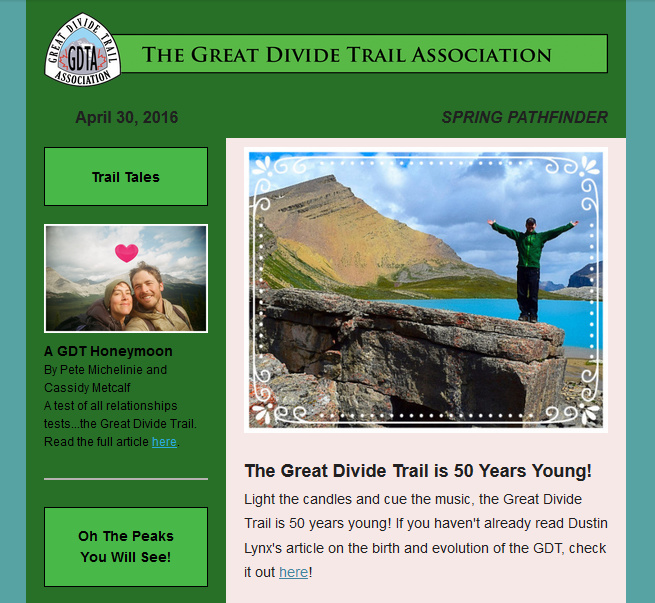
  • Pathfinder Newsletter – Spring 2016

    Check out the Great Divide Trail Association’s latest edition of Pathfinder including:

    • GDT Birthday
    • 2016 Trail Maintenance Trips
    • Maps Update
    • Sponsor Spotlight
    • Trail Tales
    • Oh The Peaks You Will See
    • Trail & Road Conditions
    • Upcoming Events
    • and more!

    You can view the latest edition of Pathfinder here.

    springpathfinderimage


  • A GDT Honeymoon

    A GDT Honeymoon

    By Pete Michelinie and Cassidy Metcalf

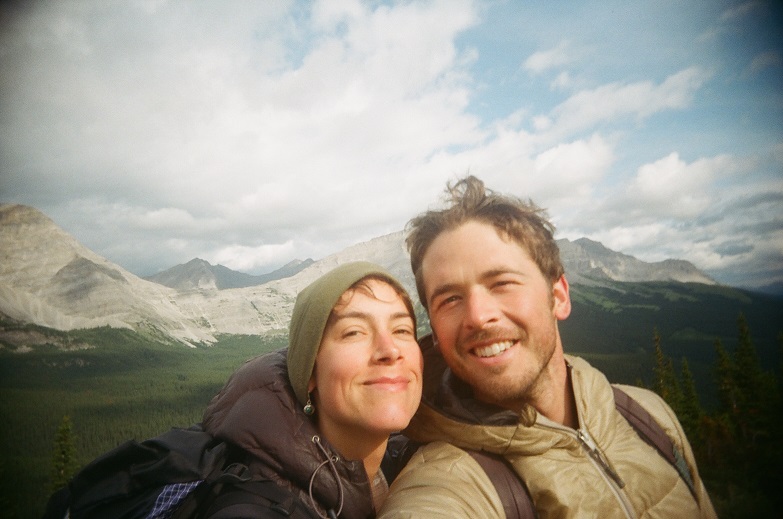
    My wife Cassidy and I took to the Great Divide Trail in July 2015 for our honeymoon and had an amazing adventure.

    To give you a brief background, I have been in love with long distance hiking since walking the Appalachian Trail after graduating from trade school in ’08.  Serious wanderlust later took me on the Pacific Crest Trail in ’10 and Continental Divide Trail in ’12.  I decided to put my education to work  and took a job in Vermont building furniture.  On the day of my interview I met Cass, who had just returned home after living in Costa Rica for a few years.  Soon after meeting we began to date, then we moved in together, then we hiked the Long Trail, and then the Annapurna Circuit, where at 16,000′ on a snowfield heading towards Talicho Tal I proposed… and she said yes! So you get the idea, we are both have itchy feet and love adventuring, which naturally led us to the GDT.

    gdt-honeymoonThe idea about hiking the GDT came to us while hearing a talk given at the 2013 ALDHA West gathering where I was receiving my triple crown award.  Cam “Swami” Honan gave a great talk about his mega-hike he did in 2012/13.  Out of all the trails he hit in North America the GDT seemed to be very near and dear to him.  Cass picked up on it and was the one who really pushed for the idea of walking it for our honeymoon.  I couldn’t say no.

    We set off July 14, 2015 from Waterton Lakes National Park and headed north.  I am a big advocate for technology-free hikes, and so we were free of cellphones, GPS, and digital cameras.  There is nothing like the reward of finding yourself when navigating with map & compass, and I wanted Cass to know the feeling.  She got the gist of it by the end of the hike, but I was our lead navigator for most of the trip.  She was the naturalist, carrying a massive (by light-weight hiking standards) field guide to the North American Rockies.  We were soon identifying all plants and animals we saw, eating Fireweed leaves and chives with dinner almost every night, Huckleberries for breakfast and lunch if we were lucky.

    The trail took us through some amazing country.  The views were stunning, the weather was harsh at times, and the trail was all over the map.  The sections in National & Provincial Parks were great, but in between there was some grade A bushwhacking.  In one section we didn’t see another soul for 5 days straight.  Nobody, not even an ATV or car from far away.  I had never experienced isolation like that before on any trail.

    Hiking the GDT on our honeymoon was the test of all relationship tests.  We experienced extreme highs; wilderness like no other, beautiful vistas, and enjoyable terrain – followed soon thereafter by some of the most difficult hiking I’ve ever known.  The first three days included a triage of hardships; hail and lightning on an exposed ridge, knee crushing terrain, and getting lost in the wilderness.  Pulling through in one piece, healthy and happy, made it all the more rewarding & memorable.

  • Oh The Peaks You Will See: Veteran Mountains – Part 1

    Oh The Peaks You Will See: Veteran Mountains – Part 1

    By Jen Peddlesden

    Who would think that World War One (WWI) had anything much to do with the Great Divide Trail (GDT)?  When I received a copy of Canmore and Kananaskis History Explorer by Ernie Lakusta as a gift from some hiking pals, its pages brought a surprise that quite a number of Rocky Mountain peaks are named after either WWI generals or battleships.  Some of these mountains appear along the GDT through Kananaskis, Smith-Dorrien and the Spray Lakes sections.  With the centenary of WWI beginning in 2014, it is fitting to feature a few of these peaks in this series.  Starting with the most southerly of the peaks I have chosen, we have Mt. Indefatigable.

    Mt Indefatigable from SE Vern Dewit Peakfinderdotcom

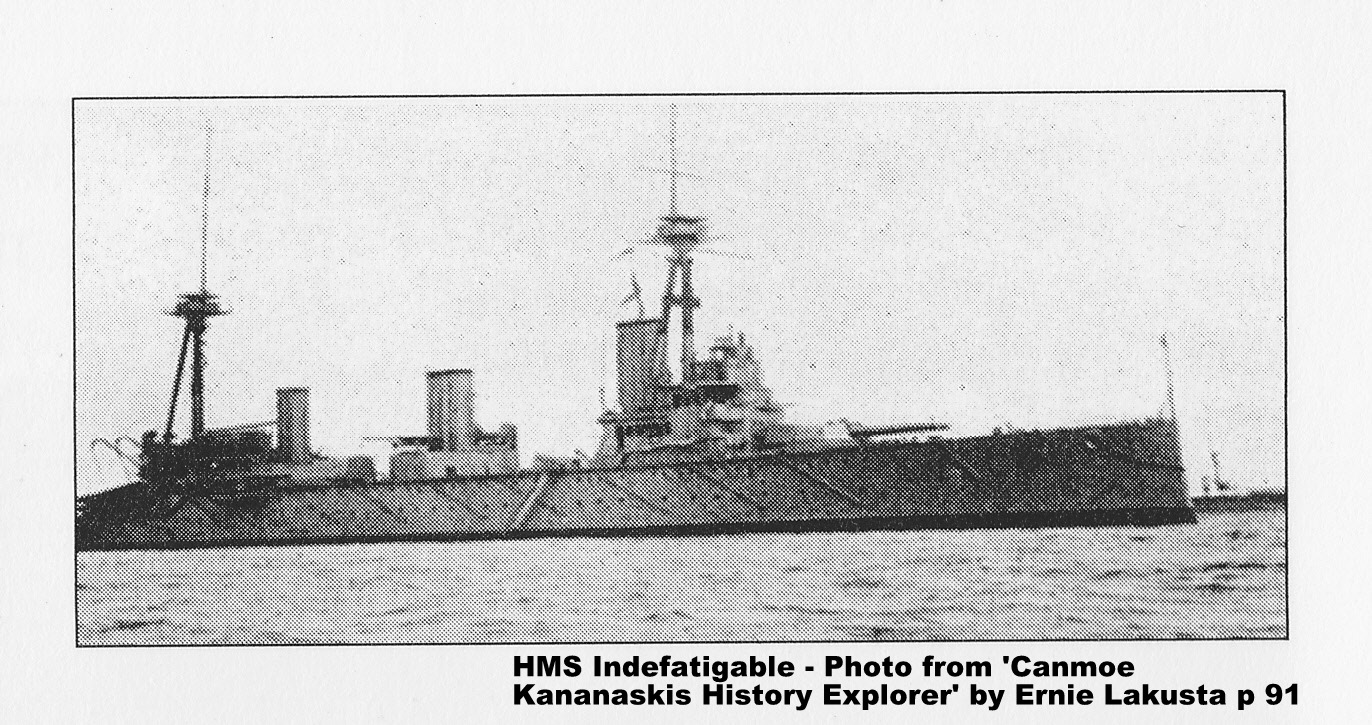
    It is one of the ‘battleship’ peaks.  The 2670-metre peak was named in 1916 by A.O. Wheeler of the Boundary Commission after a ship that took part in the Battle of Jutland.  In the Spray Range, it looms over Upper Kananaskis Lake.  Though the Stoney Indians named it Ubithka mabi (‘mountain of the nesting eagles’), Wheeler renamed the peak Mt. Indefatigable.  According to Lakusta, Wheeler disregarded the mandate of naming based on natural history and ‘in a fit of patriotism’ named most of the mountains surrounding the Upper Kananaskis after WWI generals and ships.HMS Indefatigable Lakusta p 91The battleship Indefatigable was part of the British cruiser squadron at North Sea Battle of Jutland late May 1916 between the British Royal Navy and the German High Seas Fleet.  The Indefatigable was commanded by Captain C.F. Sowerby and had the ominous distinction of being the first ship sunk at this battle.  One of the cheapest built by the British Royal Navy, it and many sister ships suffered the same fate of lacking armour to resist attack.  Indefatigable received two direct hits and sank 17 minutes after entering the battle.  Only the captain and two crew of 1020 members survived.  This ship was named for a more robust vessel, another Indefatigable, a 44 gun 18th century frigate which destroyed the French battleship Droits de L’Homme during the Napoleonic War in 1787.

    In 1964 Geological Survey reported gypsum on Mt. Indefatigable’s slopes.  It was a daunting task to build a road to the mining lease owned by Alberta Gypsum and only one carload was ever removed.  The road can be seen as a thin line traversing the slope.

    There is no official first ascent, but there is record of Walter Wilcox setting up a tripod on the south summit in 1901.  Today it is a popular scramble and a mountain one sees traversing the GDT early in the Kananaskis to Field section in Dustin Lynx’s book (p 109) ‘Hiking Canada’s Great Divide Trail.’


    END

  • Spring 2016 Trail and Road Conditions Update

    Spring 2016 Trail and Road Conditions Update

    Trail Conditions Update – April 30, 2016

    Spring is in the air! This is transition time on the GDT. Hiking trails at lower elevations vary from bare and muddy to slushy and icy, while trails at higher elevation remain snowbound with potential avalanche risk. Trails can be icy in the morning but warmer daytime temperatures are creating slushy and slippery conditions. Plan for varying conditions – warm layers and snowshoes, cleats and/or poles are recommended.

    Spring avalanche conditions still exist, especially at higher elevations so always check the latest avalanche bulletins before setting out.

    Tick season has started. Be extra careful when in areas with a lot of underbrush and check yourself and your clothing after your hike.

    TRAIL CLOSURES:

    • Jasper National Park – Trail #7 is closed to hikers at the junction with Trail #7e to the junction with Trail #7a due to grizzly and black bears frequenting the area. Detour is available by taking Trail #7e to Mildred Lake where you can follow the Beauvert Lake Trail or Athabasca River Trail to reach the Old Fort Point bridge (e34).

    TRAIL NOTICES:

    • The trail from Sage Pass (a17) to Scarpe Pass (a24) was cleared and blazed in August 2014 and is in good shape. From Scarpe Pass, the trail disappears up to La Coulotte Ridge and the hiking becomes significantly more difficult until you reach the ATV track (a27) heading down to the West Castle Road.
    • The Aldridge Creek Trail between Fording River Pass (b31) and the Kananaskis Power Line Road (b32) was cleared and restored in July 2015.
    • Cairnes Creek (d9): The bridge is washed out making this a potentially dangerous ford. It is recommended to cross early in the morning when glacial melt is lowest.
    • The damaged Lambe Creek bridge (d10) was removed in September 2015. It is recommended to ford the creek further downstream.
    • The Howse Pass Trail from Conway Creek (d12) to the Glacier Lake trail junction (d14, 15 km) is in very poor condition. The trail is overgrown, with hundreds of wind-fallen trees across the trail. Hiking in the Howse River floodplain is a viable alternative if the Howse River is low enough to ford.
    • The Owen Creek Trail was cleared in July 2015 up to km 6. Beyond that point, the trail is in poor shape with several washed out sections. Expect challenging hiking for 3 km including skirting along steep creek-side cliffs and rock-hopping in the creek itself. At km 6, do not take the trail heading up away from the creek (it is a deadend). Look for orange blazes marking the correct route staying near the creek.
    • The Maligne Pass trail in Jasper National Park has been decommissioned and is in poor shape. The trail from Pobokton Creek (e20) to Maligne Lake (e25, approx 42 km) is no longer being maintained by Parks Canada so expect deteriorating and overgrown trail conditions; long pants are recommended. The Maligne River bridge has been removed but the river can be easily forded in normal summer conditions (knee deep in mid-summer). Most other bridges are still in place. Read Nathan Dahl’s August 30, 2015 Maligne Pass trail update here.
    • The Yates Torrent Bridge is out at the crossing of the Coleman Glacier outflow (near f16). Do not attempt to cross at the old bridge location. Instead, ford the Smoky River further down the valley. Attempt to cross early in the morning when glacial melt is the lowest or be prepared for a fast and potentially dangerous creek ford.
    • The bridges across Gendarme and Carcajou Creeks are out on the Jasper North Boundary Trail. These two creeks are smaller than the Smoky River, but can still be treacherous. Cross Gendarme at the horse crossing just below the old bridge (marked), and Carcajou about 100m below the trail.
    • The bridge across Buchanan Creek, near the Kakwa Lake trailhead, has been removed. The crossing here can be hazardous early in the year or after heavy rains. In 2015, a gravel bar about 50 metres across the creek upstream provided the best crossing.

    ACCESS ROADS:

    • Annual Winter Closure of Highway 40 from the Kananaskis Lakes Trail to the junction of Highway 541 between December 1 and June 15.
    • 8:00 pm to 8:00 am closure of the Bow Valley Parkway (Highway 1A) from March 1 to June 25 on the 17 kilometre section of the parkway from Johnston Canyon Campground to the Fireside Picnic Area, to reduce disturbance and increase habitat security for sensitive wildlife species during critical times.
    • The Red Rock Parkway in Waterton Lakes National Park is closed to allow for reconstruction of the parkway and the lower parking lot at Red Rock Canyon. Starting May 6 until June 17, 2016, the Red Rock Parkway will reopen for public use on weekends only, from 2:00pm Friday until 4:00pm Sunday. Full re-opening will occur on June 17, 2016.
    • Due to the construction at Cameron Lake Day-Use Area from April to November 2016, the Cameron Lake Day-Use Area and Akamina Parkway will be closed to all traffic – including pedestrians and cyclists. Parks Canada is pursuing a complimentary shuttle service for hikers to safely access trailheads for the duration of the work. Some trailheads along the parkway may be temporarily closed for reconfiguration and then reopened sequentially as work is completed throughout the summer. The Carthew-Alderson Trail will remain open. For more information and updates, check out Parks Canada’s website.
    • Access to the northern terminus of the GDT in Kakwa Provincial Park is via the Walker Creek Forest Service Road. The Walker Creek FSR has been repaired from Highway 16 to km 33.5. While travelling the remaining 40 kilometres on the Walker Creek FSR, attention is required to navigate the surface as it is uneven, rutted, slippery and very rough. The road is not recommended for anything other than a 4×4 high clearance vehicle. The last 10km from Bastille Creek to Buchanan Creek is closed due to washouts and is not driveable by vehicle so be prepared to walk this distance on foot.


  • Pathfinder Newsletter – Winter 2015-2016

    Pathfinder Newsletter – Winter 2015-2016

    Check out the Great Divide Trail Association’s latest edition of Pathfinder including:

    • GDTA 2016 Resolutions
    • Volunteer Highlight
    • Trail Tales
    • Oh The Peaks You Will See
    • Backcountry Kitchen
    • Trail & Road Conditions
    • Upcoming Events
    • and much more!

    You can view the latest edition of Pathfinder here.

    The Great Divide Trail Association is trying something new this year and producing our Pathfinder Newsletter online. Let us know what you think of our new look and please subscribe if you would like to be included in the next seasonal edition of Pathfinder!

    Pathfinder-Winter 2016


  • Oh The Peaks You Will See: Crowsnest Mountain

    Oh The Peaks You Will See: Crowsnest Mountain

    By Jen Peddleson

    Crowsnest Mountain
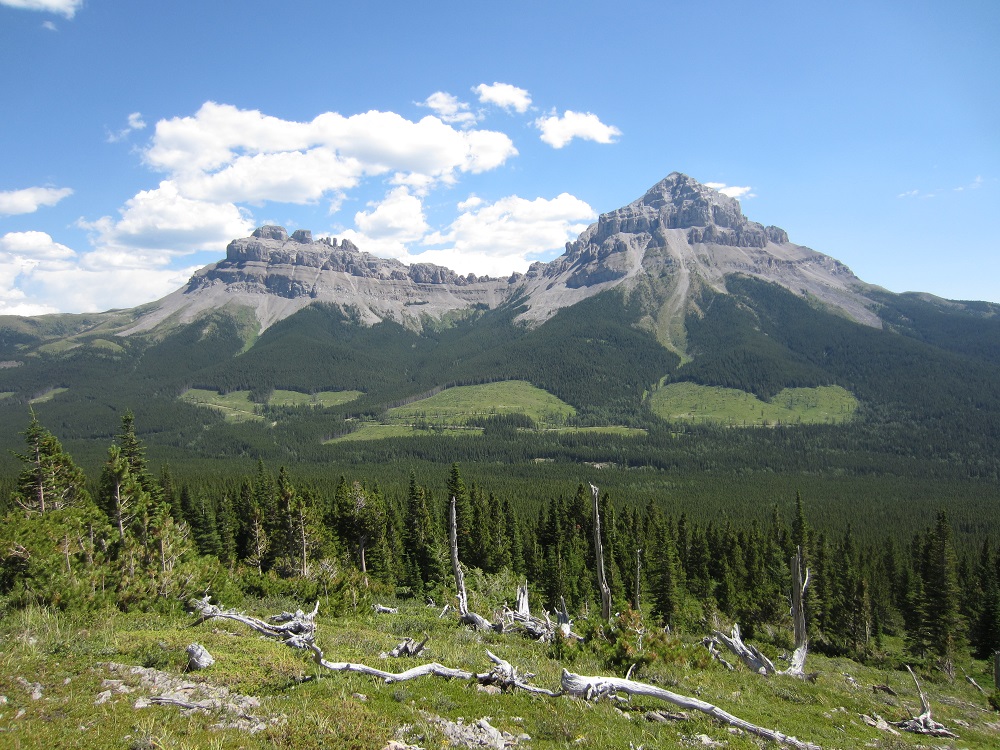
    Crowsnest Mountain (photo by Bradley Vaillancourt)

    When I asked some intrepid GDTA thru-hikers what mountain should be next in this series a resounding answer was Crowsnest Mountain. But it is not just the purview of those who hike this trail, but also lucky travellers along Highway 3 in Crowsnest Pass may gaze at its grand beauty. Specifically it lies in the Canadian Rockies in the Crowsnest River Valley between Allison Creek Valley and McGillivary Creek Valley at Latitude 49°42’20” Longitude 114°34’20” in the Municipal District of Ranchland #66, Alberta, and is found on Topo map 82G/10.

    In Section 7 (Coleman to Alexander Creek) of Dustin Lynx’s Hiking the Great Divide Trail you will find much of the GDT on motorized trails and gravel roads. Ideally the route would lie nearer the Divide. But to quote Dustin Lynx, “the castellated peaks of Seven Sisters and Crowsnest Mountain are your ever present companions” giving a bit of interest to a rather uninteresting walk.

    According to Place Names of the Canadian Alps, George Dawson, in his Geological Survey of Canada 1883-1884 noted that the Crowsnest mountain, pass, and river where originally named by the First Nations because of the big black birds which nested in the area. The Cree may have been referring to the ever present Common Raven, Corvus corax.

    There is an interesting story about the first ascent in 1904. None other than Edward Whymper, British mountaineer who did the first ascent of The Matterhorn, was interested in bagging Crowsnest peak, a mountain claimed to be ‘impossible of ascent.’ In July of 1904 he travelled to the vicinity, hired Swiss guides and sent them out to check out the route—but these men could not resist! They summited, leaving a flag, and telegraphed Whymper at his camp in Lake Louise for further orders. Whymper was not happy his employees had stolen his distinction of first ascent. Alan Kane’s Scrambles in the Canadian Rockies confirms the “tourist route” used today is much easier and was first ascended in 1915 as a solo trip.

    Crowsnest Mountain has also been called the ‘upside down mountain’ with poems written to this unique feature. It is not upside down; however, the rock at the top is older than the rock at the bottom. The upper cliffs are limestone of Paleozoic age, while lower are younger Mesozoic rock. A sheet of rock from the High Rock Range to the west, was pushed upwards and eastward riding over the younger rock. Over the eons streams have cut away the sides of Crowsnest Mountain and left the peak isolated, a beautiful island of old rocks sitting on younger rocks, a geologic, and very beautiful feature, called a ‘klippe,’ German for cliff or crag. All in all, a mountain to be revered from the Great Divide.