Author: Joan Pendleton

  • Alberta Coal Lease Impacts on the Great Divide Trail

    Alberta Coal Lease Impacts on the Great Divide Trail

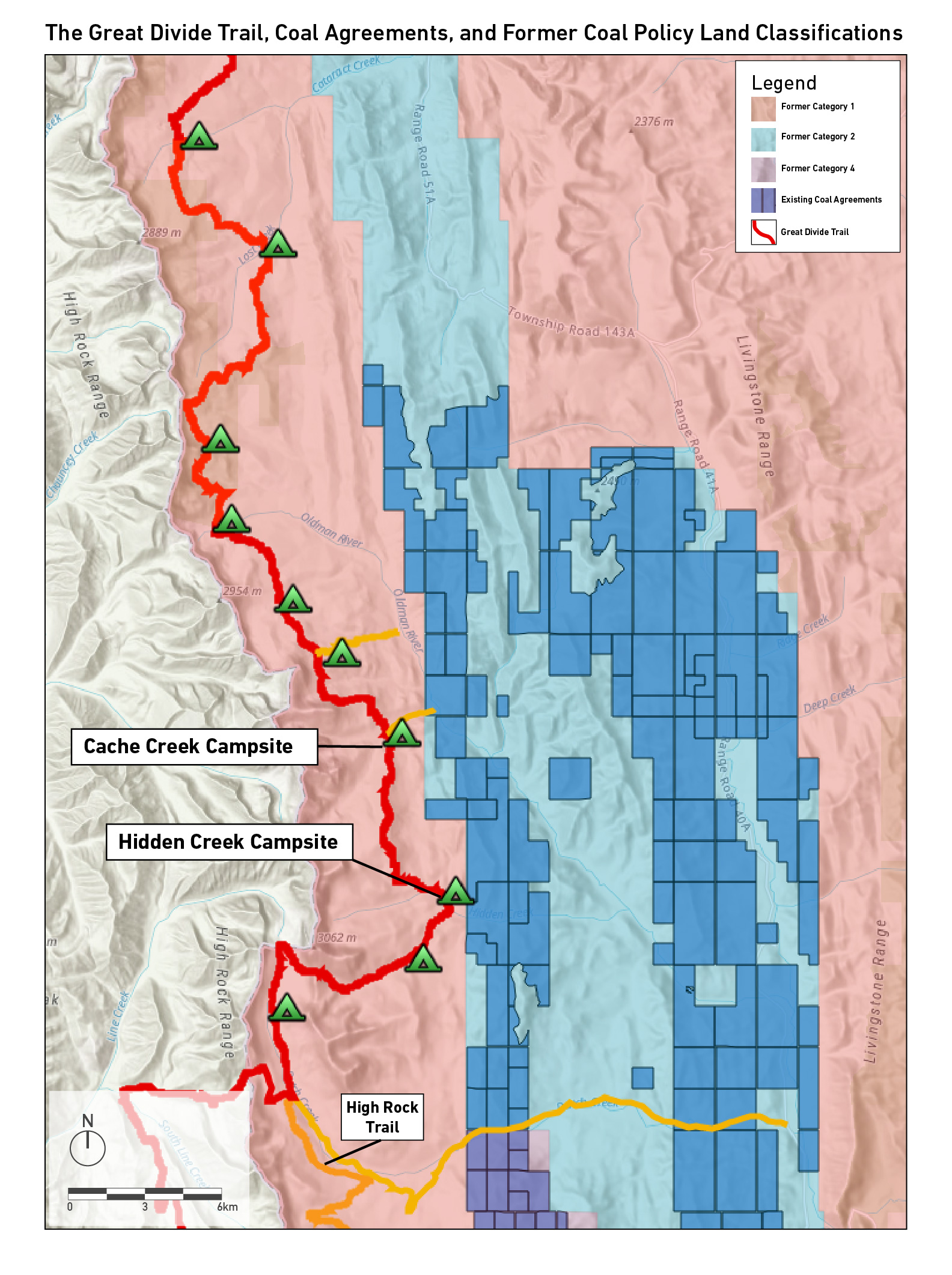
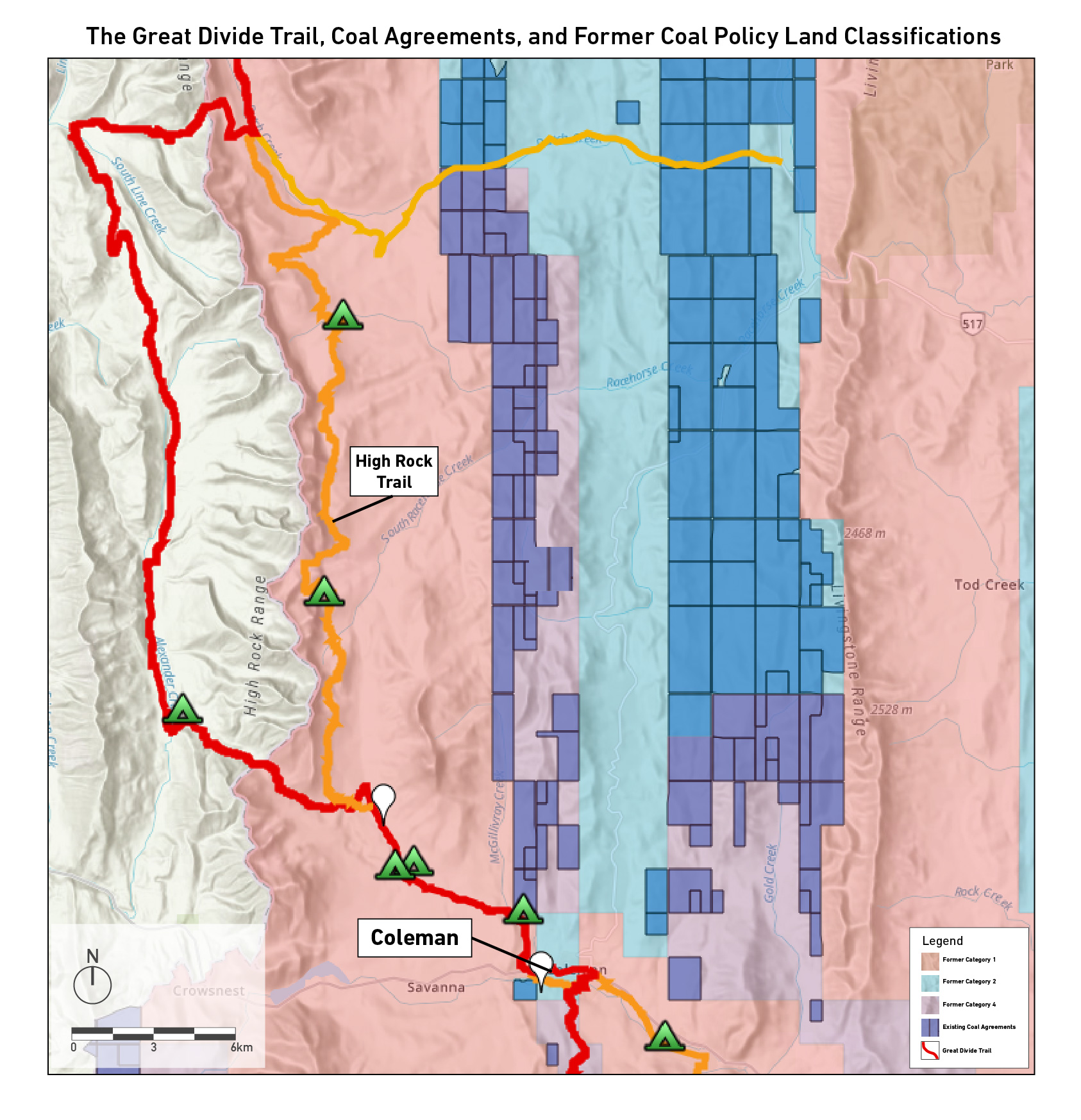
    In May 2020, the Alberta government rescinded, without public consultation, its 1976 Coal Policy, banning open-pit mining on Category 2 lands since they were deemed vital to environmental protection.  This decision to rescind exposed these Eastern Slope headwaters to coal exploration and strip-mining, and resulted in more than 350 new coal agreements.

    As a result of an outcry across the province, on January 19, 2021, Alberta’s Energy Minister, Sonya Savage, announced a temporary pause on future coal lease sales and the cancellation of 11 coal leases.   On February 8, Minister Savage further announced a change of course, and that the Alberta government is “keeping the 1976 Coal Policy in place and committing to consult on a modernized policy”, and applications for additional exploration in former Category 2 lands will be prohibited pending “widespread consultations on a new coal policy”.

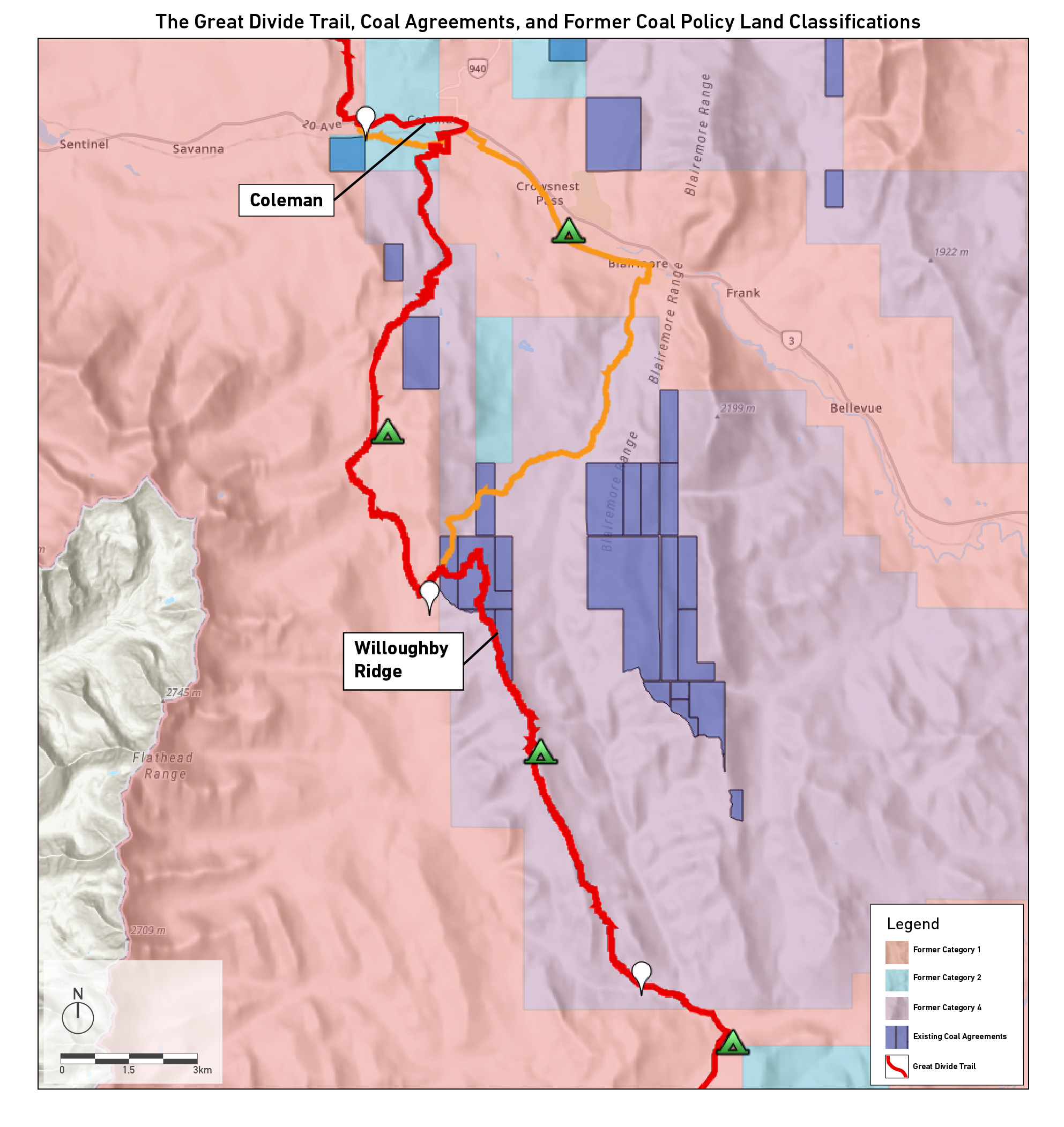
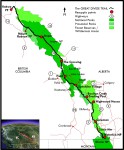
    The Great Divide Trail Association (GDTA) is pleased the government appears to be listening to Albertans who seek a voice in land-use decisions that affect these valuable headwaters, sensitive ecosystems, and critical wildlife habitats. However, the threat certainly remains with many coal leases remaining intact.  Among these intact leases are lands at the northern end of Willoughby Ridge, overlapping 4.5 km of the Great Divide Trail (GDT) – See maps below.

    GDT-CoalAgreements-sectionB-01 GDT-CoalAgreements-HighRockTrail-01 GDT-CoalAgreements-sectionA-01


    Coal exploration alone, including the installation of drill sites and exploratory roads, can negatively impact the environment and the GDT experience. However, the development of open-pit coal mining in or near the GDT’s corridor will most certainly negatively impact the world-class wilderness recreation experience the GDTA has worked hard to build over more than 40 years.  It will also reduce the environmental gains the GDTA has achieved while building and maintaining an environmentally sustainable trail along the Great Divide of the Canadian Rockies.

    The GDTA joins the voices of those Albertans who advocate for rigorous and collaborative land-use planning, where attention to the long-term impacts on water, soil, wildlife, and Alberta’s unique wilderness legacy are fully factored into policy.

  • Identifying Tracks in the Snow

    Identifying Tracks in the Snow


    Did you know: The Great Divide Trail (GDT) is a 1,095 kilometre trail running along the continental divide watershed from Waterton Lakes National Park to Kakwa Provincial Park in Canada. Each year several hundred hikers attempt to traverse the entire trail. Many more hike a small section, or volunteer with the Great Divide Trail Association.

    If you’ve found this article interesting or helpful, please consider learning more about the Great Divide Trail Association, and how you can help preserve this Canadian Treasure!


    By Jenny L. Feick, PhD
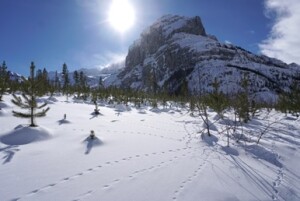
     

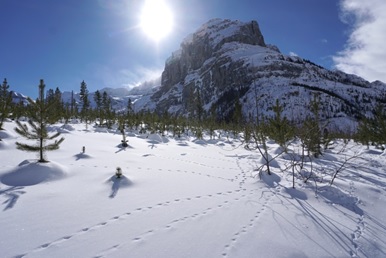
    identifying_tracks_snow_1Snow provides a blank canvas for the artistry of wildlife tracks

    Figuring out which creatures are sharing their home turf with you while you are passing through an area can provide an interesting diversion from cold oatmeal, blisters and fixing broken gear.  Winter snow provides a wonderful medium to record evidence of which animals have travelled through an area. Identifying tracks in the snow can be a bit like detective work. Consider every scrap of evidence while it exists. Snow is ephemeral and constantly changing so impressions can easily get distorted as the snow melts or sublimates, or tracks fill in with drifting snow, or get covered by debris and other tracks.

    Be sure to get a good guidebook to track identification such as Louise Forrest’s Field Guide to Tracking Animals in Snow or a wildlife tracking app like iTrack Wildlife.  You can also set up a profile within iNaturalist.ca so that others can assist you identify tracks after you upload your pictures to iNaturalist, which contains a specific project devoted to animal tracks and signs.

    Hints from the Habitat
    Know where you are and what could be there. A variety of animal species live in the Rocky Mountains in the vicinity of the GDT[1]. It helps to know what animal species frequent the part of the trail you are on. In winter, you are most likely to see the tracks of mammals and some birds.  Few reptiles and amphibians live in the Rockies and the ones that do will be hibernating in the mud or deep in their dens. Fish will be under the ice. While some arthropods such as springtails and crane-flies can flourish in mild winters (another riveting story for another issue), they don’t leave tracks that most of us notice.

    Are you snow hiking amid the Engelmann spruce and sub-alpine fir deep in a coniferous sub-alpine forest, a recently burned forest with young lodgepole pine emerging, or cross-country skiing through an open sub-alpine larch forest with its needle-less trees? Are you standing on a windswept alpine ridge or trekking over a tundra meadow? Or are you snowshoeing along an icy mountain stream, beside a frozen alpine tarn, or atop a frozen wetland with willow thickets in the valley bottom? The habitat provides clues as to what the tracks might be.  Red squirrels live in coniferous forests. River otter and mink are more likely to be seen along streams. Wolverines and wolves require large remote areas while mule deer and wapiti or elk tolerate human presence.
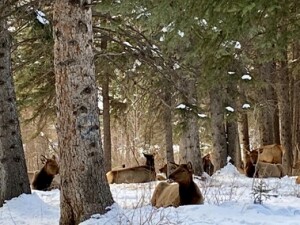
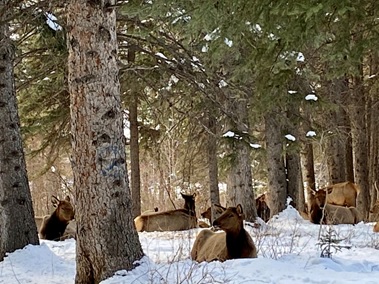
    identifying_tracks_snow_2Elk bedded down in a park in downtown Canmore, AB in January 2020

     
    Bird or mammal?
    So, usually, your first question will be, “Am I looking at the tracks of a mammal or a bird?” The most conclusive features to confirm that the tracks are avian is if you see the imprints of feathers and/or the distinctive narrow three toes forward and one back that are characteristic of perching birds like chickadees or members of the jay family.

    One of the birds most superbly adapted to mountain environments is the white-tailed ptarmigan. As it has feathered feet to protect it from the cold and a shuffling walk, the tracks can be confused with some small mammals. Like other so-called game birds such as grouse, their hind toe is small and thus not very visible. Although they can fly, ptarmigan generally prefer walking over flight to conserve energy in their unforgiving alpine habitat. In winter, this species occupies willow-dominated basins or riparian areas at or below treeline where they lead a very sedentary lifestyle, roosting in snow banks, and walking on top of the snow.
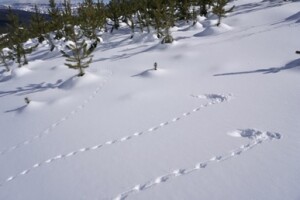
    identifying_tracks_snow_3The characteristic tracks and snow roosting holes of the white-tailed ptarmigan adorn this snow slope.

     
    What type of mammal?
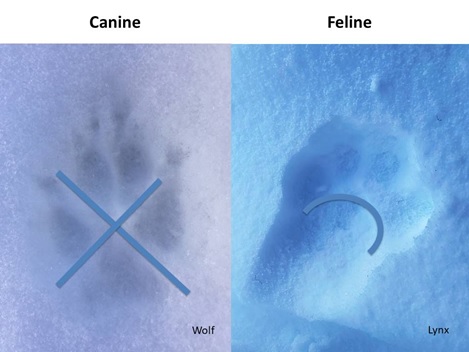
    If you have ascertained that the tracks you see do not belong to a bird, then you need to figure out what type of mammal made them. Is it a carnivore (meat-eater), an ungulate (hoofed animal), a rodent, or lagomorph (rabbit-like)? If it is a carnivore, you need to find out if it is a canid (dog-like), feline (cat-like), or mustelid (weasel-like)?  If you see claw marks, chances are the track if from one of the three wild canine species (in order of decreasing size, wolf, coyote, fox), or if associated with human tracks, a domestic dog.  You can also detect an X-shape between the paw pads as opposed to the arch- shape visible on wild feline tracks (cougar, lynx, bobcat).
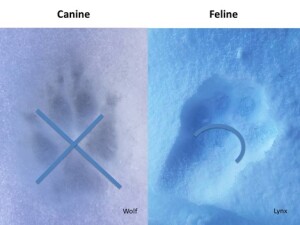
    identifying_tracks_snow_4


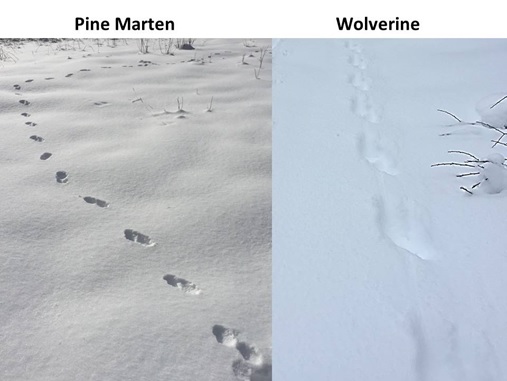
    Numerous members of the weasel family live in the Rockies. You are most likely to see the tracks of pine marten. Count yourself lucky if you find wolverine tracks, which can be tricky to distinguish from the similarly sized wolf tracks since they sometimes show claw and foot drag marks.
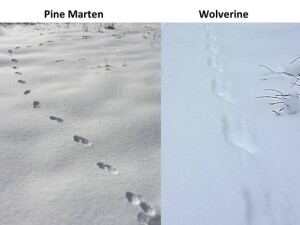
    identifying_tracks_snow_5


    If the tracks belong to an artiodactyl (even-toed ungulate) is it a member of the deer family, a mountain goat, or a Rocky Mountain bighorn sheep? Artiodactyls tend to drag their feet, especially in deep snow, so look for drag marks. Regard the shape and size of the two toes visible in the cloven-hoof print and, if the snow is deep, look for the imprint of dewclaws. Measure the straddle (width between prints) and the stride (distance between steps), and compare these against the dimensions you will find in a book on animal tracks. Artiodactyls typically place their hind feet neatly into their front hoof prints.
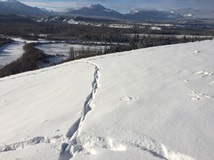
    identifying_tracks_snow_6Rocky Mountain elk and mule deer leave the vicinity of the GDT to spend winter in the valleys where the snow is not so deep.


    Track and Trail Tales
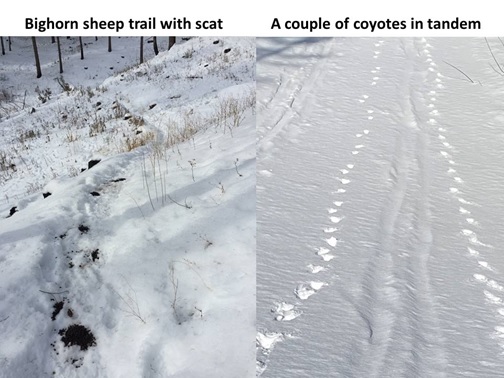
    Refine your track identification by looking at an animal’s trail, the series of tracks in the snow. You can discern a lot just by noticing the track pattern in that trail, i.e., the distinctive arrangement of the paw or hoof prints that gives you clues about its gait.  To do that, you will need to follow the animal’s trail for at least several metres to get a sense for the animal’s most typical track pattern and to look for other clues to the animal’s identity, such as scat (animal feces), urine, blood, hair, depressions in the snow from where an animal has laid down, characteristic damage to vegetation from scent marking, thrashing, browsing, etc.
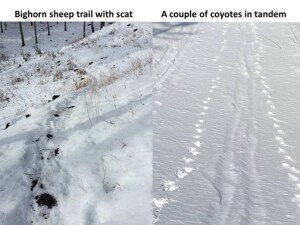
    identifying_tracks_snow_7


    What Type of Track Pattern?
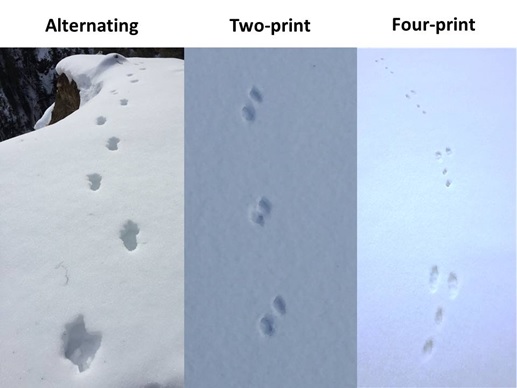
    Another step in determining the type of animal whose tracks you are investigating is figuring out its track pattern. Three primary track patterns (with variations) exist: alternating, two-print, or four-print.  Alternating tracks show two parallel rows of tracks with the prints alternately spaced. This is the pattern humans make and is typically produced when an animal walks or trots.  The two-print track pattern has two tracks close together followed by a distinct space, with two more tracks after that, and so on. In the Rockies, the animals doing this were loping, bounding, or trotting. In the four-print track pattern, four footprints are grouped together followed by a space, and then four more prints. The most common example is created by rodents and lagomorphs as they jump or hop. Startled mule deer create a very unique clustered four-print pattern while “stotting”, i.e., when they jump off all four legs at once in Pogo-stick-like movements.
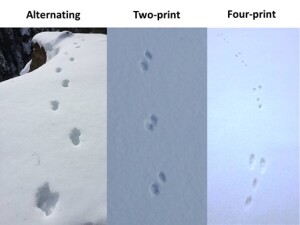
    identifying_tracks_snow_8


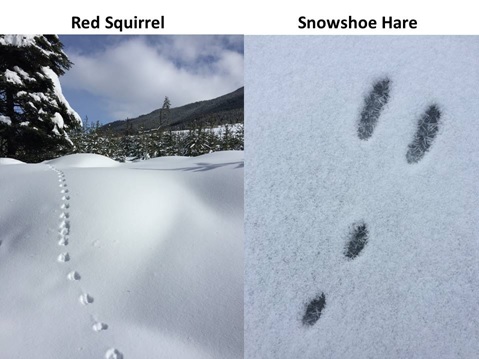
    How can you tell the difference between the tracks of two of the most common mammals in the Rockies, the red squirrel and the snowshoe hare, both of which make four-print track patterns? Tree-dwellers like squirrels place their front feet side by side while ground dwellers like hares usually place their front feet on a diagonal.
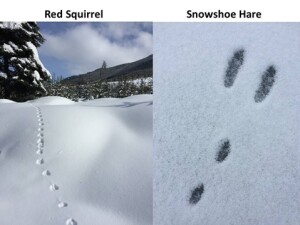
    identifying_tracks_snow_9


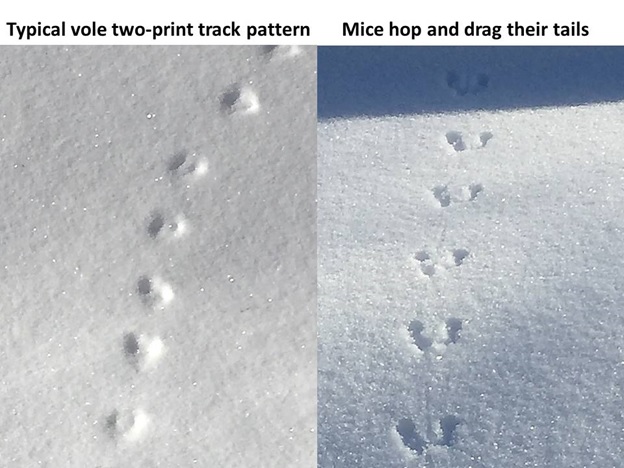
    What about the little critters? Of course, for most of the winter, mice and especially voles stay under the insulating blanket of snow as a means of conserving energy and avoiding avian and mammalian predators. When they do venture forth in search of seeds and other food, making their tiny tracks in the snow, what evidence is left behind? How do you know if you are looking at mice or vole tracks?  Mice tend to make a four-print hopping track pattern with a distinct tail drag in the snow whereas voles characteristically make a two-print pattern with no tail drag when they jump along through the snow.
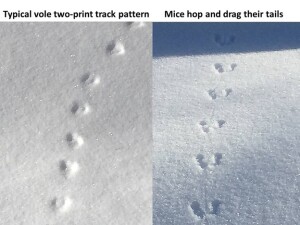
    identifying_tracks_snow_10


    What’s the Story?
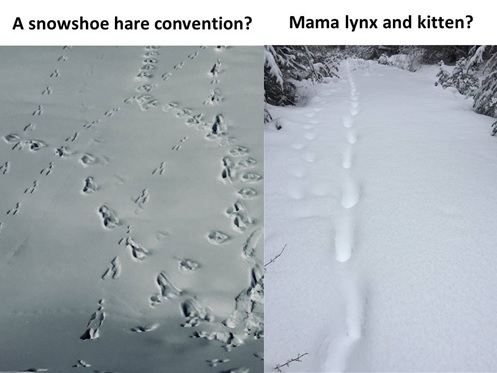
    On some occasions an atypical track pattern proves indecipherable and mysterious. Other times, one feels intrigued by the patterns and cannot help speculate about what may have transpired. Sometimes one can see tracks of more than one individual of the same species. “Could this be a playful lynx kitten intercepting the steady plodding tracks of its mom?” you wonder. Or, you realize that the tracks you see represent different species. “Hmmm, this looks like a wolf following a snowshoe hare trail.” Tracks tell a tale for those willing to use their imagination and to take the time to observe.
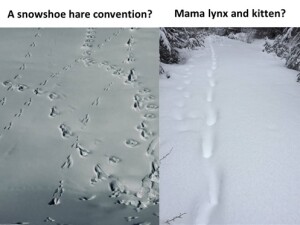
    identifying_tracks_snow_11


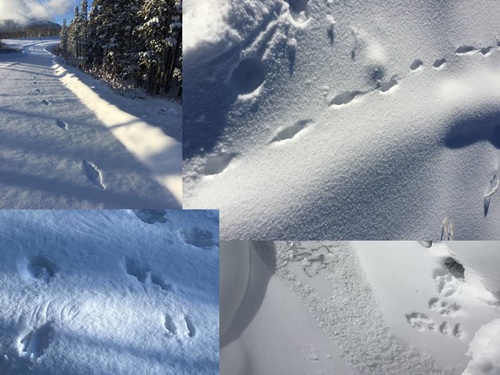
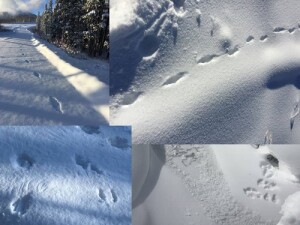
    identifying_tracks_snow_12Mystery tracks clockwise from top left: What startled animal made these distinctively-shaped large bounding prints? Which creature made this alternating pattern with tail drag beside a snow covered log? Who emerged from its hole onto the frozen stream and then turned around and went back? These hopping and feather-like patterns suggest a bird, but which one?


    While far fewer folks venture out onto parts of the Great Divide Trail in the winter, there can still be snow on much of the trail until June, with some patches lingering in summer, and snowfalls resuming again in earnest in the fall.  So, it is worthwhile investing some time and attention to develop and hone your snow tracking ID skills wherever and whenever you are out safely enjoying the great outdoors.
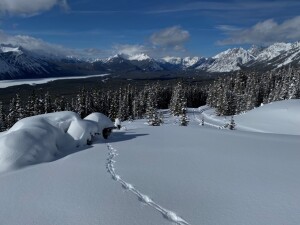
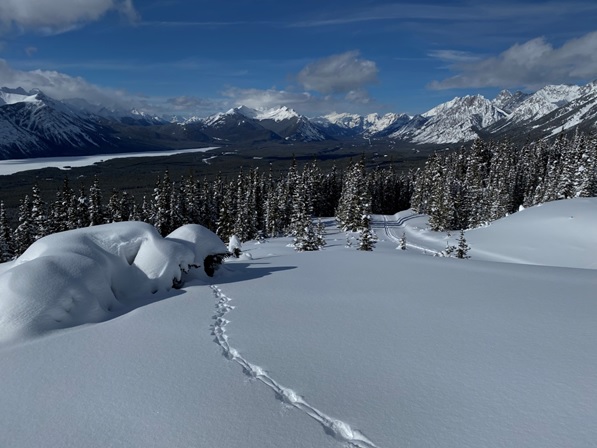
    identifying_tracks_snow_13Red squirrel and cross country ski tracks on Lookout Hill, Peter Lougheed Provincial Park, AB, March 2020


    All photographs were taken by the author in the Canadian Rockies and Columbia Mountains.

    [1] While there are over 50 species of mammals you could expect to find living year-round along the GDT, you are likely to only encounter the tracks of a small number of these during winter.  The most commonly observed tracks include mule deer, elk, moose, mountain sheep, wolf, coyote, cougar, lynx, pine marten, snowshoe hare and red squirrel, mice and voles.

  • Committee Corner Winter 2021

    Committee Corner Winter 2021

    Committee Corner is where one finds news about what various committees are working on.  Sharing news is voluntary and committees are busy, so may not always find time to share news.  We hope committee participation grows over time.  Thank you to the committees that sent news on such short notice.


    Outreach Committee News

    The GDTA Outreach Committee has some interesting things in development for members, hikers and the public in the coming few months leading into the 2021 hiking season.

    After a quiet previous year, the GDTA’s Outreach Committee has been working on some new experiences for all of us to enjoy and learn from. From exploring new possible merchandise options, developing webinars for educational and insightful topics and looking into possible trips without the sweat equity component of the trail building trips.

    The schedule for the webinars will be available mid-March, with the first presentation being offered late March. Stay tuned for details, coming soon. The Outreach Committee is looking forward to sharing these experiences with you all.

    Ensuring Financial Capacity Committee News

    We are pleased to welcome Meaghan Underhill and David Peets to the EFC Committee.  They join Mary Jane Kreisel, Co-Chair and Doug Whiteside, Interim Co-Chair of this committee.  Meaghan will be working on grants and researching funder prospects, whereas David will be developing our corporate sponsorship program.  M.J. will continue to handle the donations portfolio.  We are currently developing a work plan and revenue figures to go into the overall GDTA budget to be approved by the Board in March.


  • Our Amazing Donors

    Our Amazing Donors

    By Mary Jane Kreisel

    Last June, I wrote an article in the Pathfinder about our newly registered charitable status and how donations could support the GDTA’s work.  I am writing now to update you on the progress of our donation program and its impact on the GDTA over the last year.

    Throughout the summer and fall, we saw a steady stream of donors who generously donated on our website Donation Form.  Some even pledged monthly donations – truly, the gift that keeps on giving!

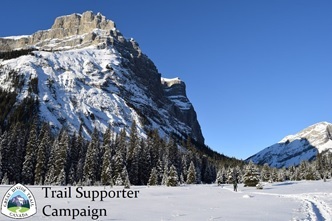
    fund_raiserOne of the photos used in our Trail Supporter Campaign

    In November and December of 2020, we held our first ever Trail Supporter Campaign – coinciding with “Giving Tuesday” and the holiday season. This campaign sought support for the GDTA and our multiple trail projects in B.C. and Alberta coming up this summer. We created a donation form unique to the campaign that could be used on mobile devices as well as our website. It also gave us the ability to track progress through a fundraising thermometer.

    We established a fundraising goal of $5,000 which some of us thought ambitious at the time. Much to our delight and surprise, we met this goal within six days – our fundraiser thermometer had almost burst! We decided to keep the campaign going to the scheduled end date of December 20.  In total, the campaign raised over $8,000 for the GDTA.

    Individual donations ranged in all shapes and sizes but what was striking was the sense that our donors were giving straight from the heart. We received a number of comments on our donation forms that were very inspirational:

    Thank you for all that you do and continue to do to make the trail so great.

    I’m a section hiker who started the GDT two summers ago and plan on finishing next summer. Keep up the good work!

    Congratulations on all you have accomplished in this challenging year.

    Walked bits and pieces of the GDT in 2020 – thank you!”

    GDTA does amazing work and I am happy to support your work.”

    Thank you for all the fantastic work you do! I had a blast thru-hiking the GDT this summer and the experience wouldn’t have been the same without the work of your volunteers.”

    It is difficult to express how much we appreciate receiving this kind of support from our donors. As we approach the end of our fiscal year on March 31, we are starting to see the impact of donors’ contributions on our financial position.  Since April 1, 2020, individual donors have brought in over $15,000 which represents about 50% of the GDTA’s total revenue this fiscal year.  Some donors have also contributed this year through Benevity (a corporate donor platform) adding another $900 to our revenue. We have gone from a projected deficit in our budget this year to a potential surplus. In a year in which we initially experienced a significant hit because of the pandemic and economic downturn, this is truly significant!

    We are planning a very ambitious trail building and maintenance season this summer. This will involve multiple projects in Alberta and BC as well as supports for our emerging youth program. Similar to last year, we will continue with safety protocols as necessary to protect our volunteers as the COVID-19 pandemic wears on.

    Our trail projects are becoming increasingly complex and multidimensional. For example, the Cairnes Creek Pedestrian Bridge project in BC will involve highly technical on-site construction and transportation to get bridge materials to this remote site.

    Our communications team continues to produce a first-class newsletter and provide critical trip planning resources to hikers and equestrians who attempt the challenge of the GDT.  The Trail Protection and Advocacy Committee remains involved in collaborative land-use planning in designated areas throughout both provinces and is carefully monitoring the impact of coal exploration along the GDT in Alberta.  Our Outreach Committee is adjusting its work to reach members and the public through alternative types of media and outdoor activities.

    The importance of donations in support of these programs cannot be overstated. The least we can say is a heartfelt “Thank you!” to all who contributed this year. This also includes our volunteers who work on the trail as well as behind the scenes to keep the organization running. The vision of a world class long-distance trail straddling the Great Divide of the Canadian Rockies – full of scenery, challenge, and adventure – is made possible by people like you.

  • A Step-by-Step Guide to Planning Your GDT Hike

    A Step-by-Step Guide to Planning Your GDT Hike

    By Charlene Deck

    The Great Divide Trail offers an unparalleled wilderness experience thanks to the numerous national parks, provincial parks, and wilderness areas through which it passes, but it requires more challenging trip planning logistics than most other long-distance trails. So where should you begin?

    getting_started


    1.    Start with a trail map

    Choose the part of the trail you’d like to explore from the Great Divide Trail’s more than 1100 kilometres.

    Tip: Read about the GDT’s seven sections to help you decide.


    2.    Plan your access

    Know your options to access the trail. Even though the GDT is remote and crosses few highways, public transportation and trailheads do exist to allow you to access the trail at various points.

    Tip: Check for updates on the access roads, including the changeable conditions of Walker Creek Forest Service Road.


    3.     Review the opening dates for campground reservations

    Note the opening dates for backcountry reservations so you can have your itinerary ready. For 2021, online reservations for Banff, Kootenay, Yoho, and Jasper national parks open on April 16th. Opening dates for provincial parks are listed here.

    Tip: Make your Waterton Lakes National Park backcountry reservations up to 90 days in advance and your townsite reservations starting on April 13th in 2021.


    4.    Plan your itinerary 

    Create your itinerary with a complete list of campgrounds to be used on your trip. For each campground, record the park in which you’ll be camping, the permit that’s required, and the opening date for reservations.

    Tip: Build some flexibility into your itinerary in case your preferred campgrounds are not available and to allow for unexpected delays. Refer to the popularity ratings of campgrounds.


    5.    Book your campgrounds

    Click here for detailed instructions on reserving your national parks backcountry permits online and for information on reserving your national parks random camping permits. Instructions for reserving provincial park backcountry campgrounds are here.

    Tip: Practice using the Parks Canada Reservation Service so you’re ready on opening day.


    6.    Plan your resupply

    Check out the resupply options. Each of these places will accept resupply packages and are access points for section hikes.

    Tip: Note the locations that sell stove fuel as it cannot be mailed through Canada Post.


    Before you go

     Learn about potential hazards, wildlife, food storage, and more.

    Find potential hiking partners and the advice of experienced hikers on the GDT Hikers Facebook group.

    Read trail journals of other GDT hikers.

    Check out Dustin Lynx’s GDT guidebook.

    Research current trail conditions and closures.

    Check out our FAQ for answers to the most frequently asked questions.


    Happy hiking!